

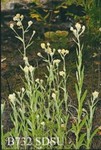
Asteraceae :Pseudognaphalium macounii
Files
Download Seed: The seed of clammy cudweed is rough and around 2 mm long. (62 KB)
Download Seedling: Two month old clammy cudweed seedling grown in research greenhouse at SDSU. (51 KB)
Download Flowers (153 KB)
Download Upper leaf surface (2.6 MB)
Download Leaf lower surface (2.4 MB)
Download Mature plants (3.3 MB)
Download Inflorescence (3.6 MB)
Family Name
Asteraceae
Common Name
Macoun’s everlasting, Macoun’s cudweed
Description
Pseudognaphalium macounii is a perennial herb growing 15 to 60 cm tall from a woody rootstock, with erect to ascending , slender stems, covered in fine, woolly hairs giving a grayish-white appearance. The leaves are alternate, with the lower leaves borne on petioles 1 to 4 cm long and upper leaves sessile; leaf blades are lanceolate to narrowly ovate, 2 to 6 cm long and 0.5 to 1.5 cm wide, with entire to slightly toothed margins, curled under near the base. Both upper and lower leaf surfaces are densely covered in woolly, white to gray hairs, creating a soft, felt-like texture. The inflorescence consists of dense clusters of small, yellowish-white flower heads arranged in terminal cluster of campanulate heads blooming from July through September. Each flower head is surrounded by an involucre of 4-5 series of cream to straw colored, papery bracts in 4.5-5.5 mm long. The calyx is modified into a pappus of fine bristles aiding in wind dispersal of the fruit. Flowers are disk florets with tubular yellow corollas approximately 3 to 5 mm long. There are 5 stamens per floret, they have slender filaments and yellow anthers, inserted near the base of the corolla tube, their anthers forming a tube around the style. The pistil has a slender style topped with a two-branched stigma. Fruit matures from August through October as a small achene, 1 to 2 mm long, topped with the pappus bristles (2–4 mm long). Native to South Dakota, Macoun’s everlasting grows in dry open woods, grasslands, and rocky slopes, often on well-drained sandy or gravelly soils predominantly in Lawrence and Pennington Counties.
Horticulture Notes
S
Seed Collection: Collect in late summer.
Germination: No treatment needed
Soils: Gravelly or sandy.
Light: Full sun.
Water: Dry to moist
Additional Notes
Macoun’s cudweed has a sweet smell and is an interesting plant that attracts butterflies but is not a visually impressive addition to a garden.