

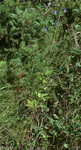
Ranunculaceae: Aconitum columbianum
Files
Family Name
Ranunculaceae
Common Name
Columbian Monkshood, Western Monkshood
Description
Aconitum columbianum is a perennial herbaceous plant typically growing 30 to 100 centimeters tall with erect, unbranched to sparsely branched stems. Leaves are alternate, deeply palmately lobed, usually with 3 to 5 broad, pointed lobes, 5 to 12 centimeters long excluding petioles, which range from 3 to 8 centimeters long and are slender. Flowering occurs from midsummer to early fall, producing several large, showy flowers arranged in terminal racemes. Each flower measures about 3 to 5 centimeters long, with five sepals—the upper sepal forming a distinctive hood or “helmet” 2 to 3 centimeters long that is typically dark purple to blue, while the lateral sepals are smaller and petal-like, approximately 1 to 1.5 centimeters long. Petals are nectar-producing and hidden within the sepals, generally two petals having elongated nectaries curved beneath the hood, about 1 to 2 centimeters long. The flower contains numerous stamens with slender filaments and small anthers clustered around a superior ovary. The pistil consists of multiple free carpels (apocarpous), each with a single ovule, a short style, and stigma. Fruits develop as a cluster of follicles, each follicle 2 to 3 centimeters long and elongate, opening to release numerous small seeds by late summer. Columbian Monkshood favors moist, shady sites—streambanks, wet meadows, montane forests—at mid to high elevations across western North America, including the Black Hills of South Dakota.
Horticulture Notes
Seed Collection: Collect seeds in late summer to early autumn when follicles turn brown and begin to split open. Seeds should be black, shiny, and firm. Wear gloves when handling to avoid skin contact with toxins (Lady Bird Johnson Wildflower Center).
Germination: Seeds exhibit morphophysiological dormancy. Best results are achieved with a warm stratification (20°C) for 2–4 weeks, followed by cold moist stratification (1–5°C) for 2–3 months. Sow outdoors in fall or stratify and sow in spring.
Vegetative Propagation: Propagate by division of tuberous roots in early spring or after flowering. Handle with gloves due to toxicity.
Soil Preferences: Prefers moist, humus-rich, well-drained soils; tolerates clay if not waterlogged.
Light Requirements: Best in partial shade to full shade; tolerates morning sun if soil moisture is high.
Water Requirements: Requires continuously moist soil; not drought tolerant. Mulch and supplemental irrigation recommended during dry periods.
Additional Notes
Aconitum columbianum is grown for its striking flowers and ornamental value in shade gardens and naturalistic plantings. All parts of the plant are highly toxic due to alkaloids (aconitine, etc.); accidental ingestion can be fatal. Historically, Native American peoples used the roots to make arrow poisons, but there are no safe medicinal or food uses. It has no known value as livestock forage and is avoided by wildlife due to its toxicity.