
-
The Changing World Religion Map: Sacred Places, Identities, Practices and Politics
Stanley D. Brunn and Robert H. Watrel
Robert H. Watrel (with Gerald R. Webster, J. Clark Archer, Stan Brunnis) is a contributing author, "Bible Belt Membership Patterns, Correlates and Landscapes."
Book description: his extensive work explores the changing world of religions, faiths and practices. It discusses a broad range of issues and phenomena that are related to religion, including nature, ethics, secularization, gender and identity. Broadening the context, it studies the interrelation between religion and other fields, including education, business, economics and law. The book presents a vast array of examples to illustrate the changes that have taken place and have led to a new world map of religions.
-
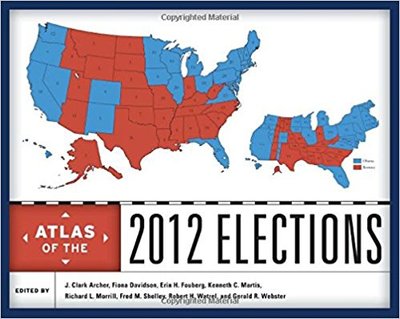
Atlas of the 2012 Elections
J. Clark Archer and Robert H. Watrel
Robert H. Watrel is a contributing author, "The Great Plains and the 2012 Presidential Election" (pp.144-146), "North Dakota Senate Election” (pp.266-267),
(with J. Clark Archer and Fred M. Stanley) “The 2012 Presidential Election in Historical Perspective.” (pp.99-114),
(with J. Clark Archer) "Chapter11: Technical Issues, Data, and Mapping.” pp. 289-296).Book description: The presidential election of 2012 was hotly contested, with polls showing President Barack Obama and Governor Mitt Romney neck-and-neck at various points during the campaign. In the end, Democrat Obama won reelection by nearly four percentage points at the national level; he won 26 states and the District of Columbia to Republican Romney’s 24 states. Obama’s victory confirmed that the election of the first African American president in 2008 was not a fluke, suggesting that racial attitudes in the United States have indeed matured in the recent past. Bringing together leading political geographers and political scientists, this authoritative atlas analyzes and maps the campaigns, primaries, general election, and key state referenda in the 2012 elections. The contributors offer a comprehensive and detailed assessment of a wide array of election issues and results including presidential primaries; newspaper endorsements and campaign stops; the results of the presidential election at the regional and national levels; and key voting patterns by race and ethnicity, religion, occupational groups, age, and poverty. Moving beyond the national race, the atlas examines important senatorial and gubernatorial races and considers selected state referenda including the marijuana votes in Colorado and Washington and same-sex marriage referenda in Maryland, Washington, Colorado, and Minnesota. The voting patterns identified in 2012 elections are also compared to earlier contests to provide political and geographic context over time.
-
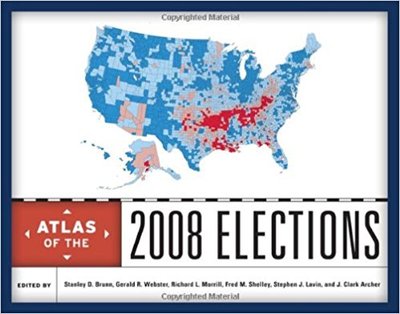
Atlas of the 2008 Elections
Stanley D. Brunn, Stephen J. Lavin, J. Clark Archer, and Robert H. Watrel
Robert H. Watrel is a contributing author, "Metropolitan, Micropolitan, and Rural Voting in the 2008 Presidential Election" and "The Great Plains and the 2008 Presidential Election."
Book description: The U.S. presidential election of 2008 was one of the most significant elections in recent American history. Bringing together leading geographers and political scientists, this authoritative atlas analyzes and maps the campaigns, primaries, general election, and key state referenda to provide a rich picture of this watershed event. The contributors offer a comprehensive and detailed assessment of all aspects of the election, providing presidential results at the national level, in major regions, and in swing states. Drilling down to county level, they trace voting patterns for key racial, ethnic, religious, and occupational groups. They also illustrate the campaign strategies of Democratic and Republican party leaders. Moving beyond the national race, the atlas compares important senatorial and gubernatorial races to presidential votes and considers selected state referenda such as marriage amendments, farm animal cruelty, stem cell research, and physician-assisted suicide. For added context and depth, the 2008 election results are compared with previous national elections.
Printing is not supported at the primary Gallery Thumbnail page. Please first navigate to a specific Image before printing.