
This collection houses capstone projects completed by undergraduate students in the Honors College.








-
Benefits of the Snakemake Workflow Management Software in Comparison to Traditional Programming (Paper)
Josh Loecker and Patrick Ewing
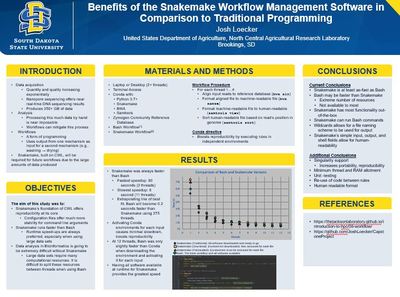
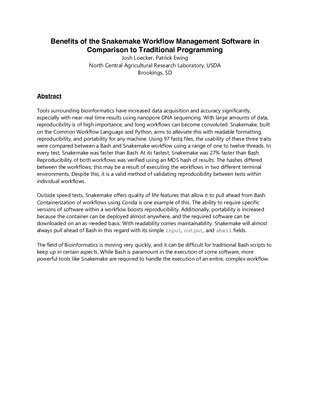
Tools surrounding bioinformatics have increased data acquisition and accuracy significantly, especially with near-real time results using nanopore DNA sequencing. With large amounts of data, reproducibility is of high importance, and long workflows can become convoluted. Snakemake, built on the Common Workflow Language and Python, aims to alleviate this with readable formatting, reproducibility, and portability for any machine. Using 97 fastq files, the usability of these three traits were compared between a Bash and Snakemake workflow using a range of one to twelve threads. In every test, Snakemake was faster than Bash. At its fastest, Snakemake was 27% faster than Bash. Reproducibility of both workflows was verified using an MD5 hash of results. The hashes differed between the workflows; this may be a result of executing the workflows in two different terminal environments. Despite this, it is a valid method of validating reproducibility between tests within individual workflows. Outside speed tests, Snakemake offers quality of life features that allow it to pull ahead from Bash. Containerization of workflows using Conda is one example of this. The ability to require specific versions of software within a workflow boosts reproducibility. Additionally, portability is increased because the container can be deployed almost anywhere, and the required software can be downloaded on an as-needed basis. With readability comes maintainability. Snakemake will almost always pull ahead of Bash in this regard with its simple input, output, and shell fields. The field of Bioinformatics is moving very quickly, and it can be difficult for traditional Bash scripts to keep up in certain aspects. While Bash is paramount in the execution of some software, more powerful tools like Snakemake are required to handle the execution of an entire, complex workflow.
-
The Effect of Freezing as a Storage Method on Anthocyanin Concentration in Blueberries
Marin E. Plumb
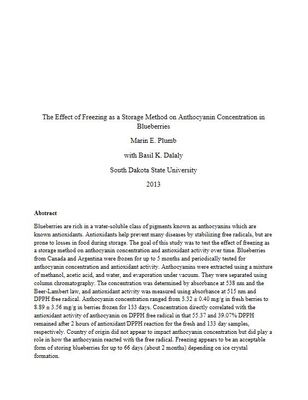
Blueberries are rich in a water-soluble class of pigments known as anthocyanins which are known antioxidants. Antioxidants help prevent many diseases by stabilizing free radicals, but are prone to losses in food during storage. The goal of this study was to test the effect of freezing as a storage method on anthocyanin concentration and antioxidant activity over time. Blueberries from Canada and Argentina were frozen for up to 5 months and periodically tested for anthocyanin concentration and antioxidant activity. Anthocyanins were extracted using a mixture of methanol, acetic acid, and water, and evaporation under vacuum. They were separated using column chromatography. The concentration was determined by absorbance at 538 nm and the Beer-Lambert law, and antioxidant activity was measured using absorbance at 515 nm and DPPH free radical. Anthocyanin concentration ranged from 3.32 ± 0.40 mg/g in fresh berries to 8.89 ± 3.56 mg/g in berries frozen for 133 days. Concentration directly correlated with the antioxidant activity of anthocyanin on DPPH free radical in that 55.37 and 39.07% DPPH remained after 2 hours of antioxidant/DPPH reaction for the fresh and 133 day samples, respectively. Country of origin did not appear to impact anthocyanin concentration but did play a role in how the anthocyanin reacted with the free radical. Freezing appears to be an acceptable form of storing blueberries for up to 66 days (about 2 months) depending on ice crystal formation.