

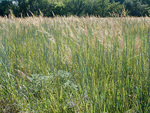
Poaceae : Sorghastrum nutans
Files
Download Seed: The seed of indian grass (57 KB)
Download Seedling: Indian grass seedlings one month after germinating. (105 KB)
Download Mature plants (651 KB)
Download Vegetative: The firm ligule is 1.5 to 7 mm long. (64 KB)
Download Flowering: A panicle of the inflorescence is 11-27 cm long. (405 KB)
Download Fruiting: Indian grass producing fruit in late September at the research garden near SDSU. (503 KB)
Download Ligule (2.2 MB)
Download Florets (3.5 MB)
Download Culm Xsec (2.0 MB)
Download Plants (5.9 MB)
Family Name
Poaceae
Common Name
Indian grass
Native American Name
Lakota: pȟeží šašá íŋkpa žiž
Description
Sorghastrum nutans is a perennial, warm-season bunchgrass with a fibrous root system and short, scaly rhizomes, forming loose, upright clumps. Mature stems are erect, stout, round, hollow, culms, 0.6-2 m tall, that have hairy nodes, often with a bluish green to golden hue. Leaves are alternate, simple, the blades are rolled in the bud and flat at maturity, 5-60 cm long, 3-12 mm wide, with a prominent midrib near the base and rough margins. The sheath is smooth to hairy, with projections from the collar and joined to the firm, membranous ligule that is 2-7 mm long, fringed with long, silky hairs. The upper surface is green and smooth, while the lower surface is slightly paler and may be finely hairy near the base. Leaf blades taper gradually to a pointed tip. Flowering occurs from August to October, with the inflorescence forming a narrow, plume-like, golden-brown panicle 15–30 cm long, composed of many paired spikelets. Each spikelet is 8–10 mm long, with a single fertile floret and a conspicuous, bent, twisted awn (15–20 mm long) extending from the lemma. The hairy, subequal glumes are lanceolate, 7–10 mm long, yellowish to purplish, and often shiny. Stamens are three per floret, with large, yellow anthers (3–5 mm long) that dangle from the florets at anthesis. The pistil consists of a single ovary, a slender style, and two feathery stigmas. The fruit is a small, brown, ellipsoid caryopsis (grain), 4–5 mm long, maturing in late fall and often retained in the inflorescence through winter. Indiangrass is native to South Dakota and occurs throughout the state, especially in prairies, open woodlands, roadsides, and other well-drained, sunny habitats.
Horticulture Notes
Seed collection: Collect mature, golden-brown panicles in September and October when spikelets are dry and easily detach from the stem.
Germination: Seeds may have dormancy and benefit from cold, moist stratification (30–60 days); best sown on the surface or shallowly covered in fall or early spring.
Vegetative propagation: Propagated by division of clumps or rhizomes in early spring.
Soils: Prefers well-drained, loamy or sandy soils; tolerates a range of soil types but does poorly in wet, heavy clay.
Light: Requires full sun for optimal growth and flowering.
Water: Moderate drought tolerance; grows best with occasional moisture but does not tolerate prolonged flooding.
Additional Notes
I
Indiangrass is highly valued horticulturally and ecologically for its striking, golden fall plumes, excellent wildlife cover, and ability to stabilize soils. It is a dominant species in tallgrass prairie restorations and provides critical forage for grazing animals, nesting habitat for birds, and food for pollinators and seed-eating wildlife. The species is also used for ornamental landscaping due to its height, color, and movement in the wind.