

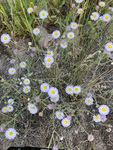
Asteraceae: Erigeron divergens
Files
Family Name
Asteraceae
Common Name
Spreading fleabane
Description
Erigeron divergens is annual to weakly perennial herb with erect stems, 10–40 cm long, often branched at the base from a simple caudex, the stems covered with short stiff and/or glandular hairs. . Leaves are alternate and mostly basal, linear to narrowly lanceolate or spatulate, measuring 2 to 7 cm long and 3 to 12 mm wide, with petioles from sessile up to 2 cm, margins are entire to slightly toothed. These leaves are usually deciduous by flowering. The simple, cauline leaves are reduced in size, linear to lanceolate, and tapering; leaves often have a silvery or bluish-green hue due to fine hairs. Flowering occurs from late spring through fall (May–September). Inflorescences consist of clusters or solitary flower heads with both ray and disc florets. Flowers are bisexual. Each flower head contains 70 – 150 ray flowers with blue to pink to white ligules, 5-10 mm long and numerous yellow disk flowers, 2–3 mm long. These florets have tubular corollas with five lobes, stamens form a tube around the ovary, and there is a single pistil with bifid style tip. The involucre is composed of several (3 to 5) series of overlapping greenish to reddish, narrow, lanceolate bracts (phyllaries) with membranous margins, a brown midvein, and often with fine hairs, forming a bell-shaped to cup-shaped structure surrounding the flower base. The fruit are achenes about 1 mm long. Spreading fleabane is native to South Dakota, found in dry prairies, open woodlands, rocky slopes, and disturbed sites, widely distributed but most common in western and central parts of the state.
Horticulture Notes
Seed collection: Collect drying heads in late summer and remove seeds.
Germination: Fall or spring sowing. Plant very shallow as they need light to germinate.
Light: Full sun to partial shade.
Soil: Well drained light soils.
Water: Medium dry to dry, once the seedlings are established.
Additional Notes
Spreading fleabane provides a profusion of flowers in the early summer, with frilly flowers that range from blue to white in color and that attract several species of native bumblebees and butterflies. It is short-lived but will reseed itself. It is drought tolerant and is a great addition to a native prairie garden.