

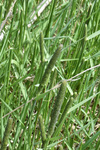
Poaceae: Alopecurus pratensis
Files
Family Name
Poaceae
Common Name
Meadow foxtail
Description
Alopecurus pratensis is a perennial grass in the Poaceae family. It forms dense tufts from a fibrous root system and can also spread via short rhizomes, sometimes forming loose sod. The stems (culms) are erect, simple, and unbranched, typically 40–110 cm in height and are smooth with little or no pubescence. Leaves are mostly basal, soft, flat, and linear, 3–10 mm wide and up to 35 cm long, with a rough texture and finely serrated margins; the ligule is long (up to 8 mm), membranous, and pointed, which is a distinguishing feature. Cauline leaves are fewer and shorter. Inflorescences appear from April to June and are dense, cylindrical spikes (5–12 cm long) that resemble a fox’s tail. Each bisexual spikelet is subtended by two glumes and contains a single floret with one lemma, a short palea, and a straight awn (5–8 mm) extending just beyond the glumes. The fruit is a caryopsis (grain), 2–3 mm long, narrow, and brown at maturity, ripening in early to mid-summer. Meadow foxtail is an introduced, cool-season grass in South Dakota, commonly found in moist meadows, pastures, ditches, and along streambanks, and is most abundant in the eastern part of the state and areas with higher soil moisture.
Additional Notes
Meadow foxtail is not native to North America; it is widely used in horticulture and agriculture as a forage grass for hay and pasture, valued for its early spring growth and palatability to livestock. It provides cover and food for some native insects and ground-nesting birds but can outcompete native grasses in wetter habitats.