

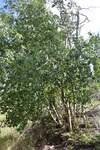
Betulaceae: Betula papyrifera
Files
Family Name
Betulaceae
Common Name
Paper Birch, Canoe Birch, White Birch
Native American Name
Lakota: čhaŋhásaŋ
Description
Betula papyrifera is a medium to large deciduous tree, reaching 15–25 meters tall, with a shallow, wide-spreading root system and reproducing sexually by seed and vegetatively by stump or root sprouting. The trunk is slender, up to 60 cm in diameter, with thin, white, peeling bark marked by horizontal lenticels and often curling in papery sheets; younger bark may be reddish-brown. Twigs are slender, reddish-brown, and lack hairs. Leaves are alternate, simple, ovate to rhombic, typically 5 to 10 centimeters long and 4 to 8 centimeters wide, with doubly serrate margins and a pointed apex and a rounded or heart-shaped base. Petioles are slender and about 1 to 3 centimeters long. Both leaf surfaces are hairless or sparsely hairy when young, and leaves turn bright yellow in autumn. Flowering occurs in early spring before or as the leaves unfurl. Flowers are borne in separate male and female catkins on the same tree (monoecious). Male catkins are pendulous, cylindrical, and 3 to 8 centimeters long, releasing pollen in early spring before leaf emergence. Female catkins are shorter, erect, and take the growing season to mature. Male flowers have several stamens with pollen-producing anthers; female flowers consist of superior ovaries. Fruits are small winged nutlets (samara-like), clustered in cone-like catkins that open in fall to release seeds. Seeds mature in late summer to fall Paper Birch is native to South Dakota and widespread in moist woods, streambanks, lakeshores, and upland slopes, especially in the Black Hills and northern parts of the state.
Horticulture Notes
Seed Collection: Collect seeds in late summer and fall when catkins are brown and begin to break apart; seeds are tiny, winged, and wind-dispersed. Germination: Seeds require light and exposure to cold-moist stratification (60–90 days); sow on the soil surface in spring.
Vegetative Propagation: Propagation by cuttings or stump/root sprouting is possible but less common than seed.
Soils: Prefers moist, well-drained sandy or loamy soils, but tolerates a range of soils if drainage is adequate.
Light: Full sun is best; shade intolerant and will not compete well under a closed canopy.
Water: Prefers moist conditions, especially when young, but established trees tolerate periodic dryness.
Additional Notes
Paper Birch has been widely used by Indigenous peoples and settlers for its bark, wood, and sap. The bark was traditionally used for making canoes, baskets, containers, and as a waterproof covering. The inner bark, although edible, was more commonly used as emergency food or for medicinal teas. The sap can be tapped in spring and consumed fresh or boiled into syrup. The wood is valued for fuel and for making furniture, tools, and craft items. The species is important for wildlife—providing food for birds, moose, and beaver, and habitat for numerous insects.