

Boraginaceae: Buglossoides arvensis
Files
Family Name
Boraginaceae
Common Name
Corn Gromwell, Field Bugloss
Description
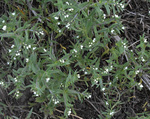
Buglossoides arvensis is an annual or biennial herb with an erect growth form, typically reaching 30–80 cm in height. It has a taproot system and reproduces solely by seed. The stems are branched and densely covered with rough, short hairs, giving a bristly texture. Leaves are alternate, simple, lanceolate to ovate-lanceolate, 3–10 cm long, with entire or slightly toothed margins, and rough, hairy surfaces. Basal leaves are larger and ovate, while cauline leaves are smaller and narrower. Flowering occurs from late spring to early fall. The inflorescence is a scorpioid cyme—a coiled cluster of small, tubular flowers 8–12 mm long, with five fused petals forming a trumpet shape. Flowers are pale blue to violet with darker markings and a hairy throat. Each flower has five sepals, five stamens attached to the corolla, and a single pistil. The fruit is composed of four small nutlets (seeds), maturing in late summer. Native to temperate Europe and Asia, Corn Gromwell has been introduced and naturalized in parts of North America, including South Dakota, where it grows in disturbed fields, roadsides, and agricultural lands, mostly in eastern and central regions.
Additional Notes
Corn Gromwell is a non-native plant that is not recommended for native plantings. It has been planted as a cover crop and for its seeds, which are rich in omega-3 fatty acids. It also aids soil improvement and erosion control in agriculture. The plant attracts pollinators such as bees and butterflies.