

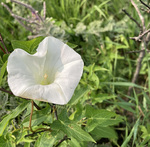
Convolvulaceae: Calystegia sepium
Hedge bindweed is considered a noxious weed in many regions due to its aggressive spread and ability to smother crops and native plants The plant’s vigorous rhizomes and climbing stems can choke out other vegetation, making it a serious pest in gardens, fields, and natural habitats.
Description
Calystegia sepium is a perennial herbaceous vine with a deep, extensive, and persistent rhizomatous root system, which enables aggressive asexual reproduction and spread. Stems are long, slender, twining, and can grow prostrate or climb up to 3 meters or more by winding around other plants or structures; stems are smooth, hairless, and often form dense tangles. Leaves are alternate, simple, and sagittate (arrowhead-shaped), typically 5–10 cm long and 3–7 cm wide, with pointed tips, wide basal lobes, and entire margins; petioles are long and slender. Only cauline leaves are present, as the basal leaves are quickly overtaken by stem growth. Flowering occurs from late spring to early fall (May–September). Flowers are solitary or paired in the leaf axils, each on a long peduncle. Each bisexual flower has 5 small green sepals, surrounded by two large, leafy bracts (calyces) that cover the base of the flower; the corolla is funnel-shaped, white to pale pink, 4–7 cm across, with 5 slightly fused petals. There are 5 stamens with white filaments and a single compound pistil with a slender style and two stigmas. The fruit is a small, round capsule (about 1 cm), turning brown at maturity and splitting to release 2–4 large, dark brown, rough-textured seeds (4–5 mm). Hedge bindweed is an introduced species in South Dakota, commonly found in moist ditches, fencerows, riverbanks, wetlands, roadsides, and disturbed sites, and is most abundant in the eastern half of the state but can occur statewide.