

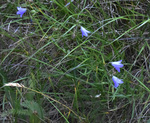
Campanulaceae: Campanula petiolata
Files
Family Name
Campanulaceae
Common Name
Tall bellflower
Description
Campanula petiolata is a perennial herb growing from a slender, fibrous root system and can form small colonies via short rhizomes, but is not aggressive in its spread. Stems are erect, simple or occasionally branched, typically ranging from 30–100 cm tall, and are smooth or sometimes minutely hairy, especially on the upper parts. Leaves are alternate; the basal leaves are ovate to heart-shaped, 2–8 cm long, with long petioles and coarsely toothed margins, while cauline leaves are smaller, more lanceolate or linear, and have shorter petioles or may be sessile. Flowering occurs from late spring through summer (June–August). Flowers are borne singly or in loose racemes at the top of the plant. Each flower is bisexual, with a bell-shaped (campanulate) corolla, blue to violet in color, 2–4 cm long, and divided into five spreading lobes, each lobe about 5 to 9 millimeters long. There are five narrow, green fused sepals forming a narrow cup, approximately 5 to 8 millimeters long, usually shorter than the corolla. The flower has five stamens with the anthers fused into a tube, and a single pistil with a three-lobed style and stigma. The fruit is a small, upright, cylindrical capsule (5–10 mm), turning brown at maturity in late summer or early fall, and containing many tiny, brown seeds (less than 1 mm). Tall bellflower is native to South Dakota, occurring in moist meadows, open woods, shaded riverbanks, and rocky slopes, and is found primarily in the Black Hills, Coteau des Prairies, and other cooler, moist upland areas, but is not widespread statewide.
Horticulture Notes
Seed Collection: Seeds are mature when capsules turn brown and begin to split at the top; mature seeds are tiny, dry, and brown, typically ready for harvest in late summer to early fall.
Germination: Seeds are best sown in fall or after a cold stratification period of 2–4 weeks; light aids germination, so sow on the surface of the soil in early spring or fall.
Vegetative Propagation: Can be propagated by division of basal clumps or rhizomes in early spring or fall.
Soils: Prefers moist, well-drained soils rich in organic matter, but tolerates a range of soil types.
Light: Grows well in partial shade to full sun, though it prefers some protection from intense midday heat.
Water: Requires regular moisture, especially during establishment and flowering, but tolerates short dry periods once mature.
Additional Notes
Tall bellflower is native and valued for its ornamental qualities in horticulture, especially in naturalized or wildflower gardens. It attracts native pollinators, including bees and butterflies.