

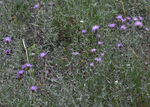
Asteraceae: Centaurea stoebe
Files
Family Name
Asteraceae
Common Name
Spotted knapweed
Description
Centaurea stoebe is a biennial or short-lived perennial forb in the Asteraceae family. It grows from a deep, stout taproot. Plants form a basal rosette of deeply divided, grayish-green leaves in the first year, with leaves 5–25 cm long, narrow and deeply pinnately lobed with irregular, toothed margins, giving them a somewhat fern-like appearance. In the second year, one or more erect, branched stems arise from the rosette, typically 40–120 cm tall; stems are slender, rough to the touch, and covered with short, stiff hairs. Cauline leaves are smaller, linear or narrowly lanceolate, becoming progressively smaller and simpler in shape, often lanceolate or narrowly elliptic, and less deeply lobed or sometimes nearly entire, typically ranging from 3 to 7 cm in length. Leaf surface texture is mostly sparsely hairy with a rough feel. Flowering occurs from June to September. Inflorescences are solitary or in loose clusters at the ends of stems, each composed of a single flower head (capitulum) atop a short stalk. Each head is 1–2 cm across, containing numerous tubular disc florets that are pink to purple in color. Each floret has a five-lobed corolla, with lobes that are slightly spreading, presenting a somewhat thistle-like appearance. The involucre surrounding the flower head is characterized by several layers of overlapping bracts, which are brownish to black with distinctive dark, purplish to black tips, often spotted, and fringed with fine hairs that give a "spotted" look—a key trait for species identification. These bracts typically measure about 1.5 to 2.5 cm long. Fruits are small, brown, ribbed achenes (2–3 mm) with a short, fringed pappus, maturing from late summer into fall. Spotted knapweed is an introduced species classified as a noxious weed in South Dakota, commonly invading roadsides, rangelands, pastures, fields, gravelly or sandy soils, and
Additional Notes
Spotted knapweed is not native to North America and is designated as a noxious weed because it forms dense stands that displace native plants and reduce forage for livestock and wildlife. The plant produces allelopathic chemicals that inhibit the growth of competing vegetation. It is not used in horticulture and is considered detrimental to prairie and rangeland health. It is not toxic to humans or livestock, but its value as forage is negligible when mature.