

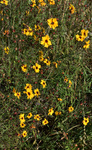
Asteraceae: Coreopsis tinctoria
Files
Family Name
Asteraceae
Common Name
Plains coreopsis, calliopsis, golden tickseed
Native American Name
Lakota: čhaŋȟlóǧaŋ wakȟályapi
Description
Coreopsis tinctoria is an annual herb with a fibrous root system. Stems are erect, slender, branched, and typically 30–90 cm tall, with a sparse covering of fine hairs. Leaves are opposite to alternate, highly variable, simple to pinnately divided, linear to lanceolate, leaflets 1–4 cm long and 1–5 mm wide, with entire or slightly toothed margins; both basal and cauline leaves are present. Basal leaves tend to be larger and more deeply lobed, while upper leaves are smaller and simpler, but basal leaves are often lost by flowering. Flowering occurs from June to September. The inflorescences are terminal and bear large, solitary flower heads (capitula) about 3–5 cm across. Each flower head is composed of bright yellow ray florets each approximately 15–30 mm long and 5–10 mm wide, with red to maroon centers. The central disc florets that are deep maroon to purple, tubular, about 5–7 mm long, and very numerous, creating a dense, contrasting center. Flowers are bisexual, with 5 fused petals in ray florets and tubular disc florets with 5 lobes, multiple stamens, and a single pistil. Fruit is an achene, brown to black, about 3–4 mm long, maturing in late summer. Plains coreopsis is native to South Dakota and thrives in open prairies, roadsides, disturbed areas, and dry upland soils, distributed statewide but more abundant in the eastern and central regions.
Horticulture Notes
Seed Collection: Seeds are mature when flower heads dry, and achenes are easily detached, usually by late summer to early fall.
Germination: Seeds germinate readily without pretreatment; best sown in spring after the last frost.
Vegetative Propagation: Not propagated vegetatively; grown from seed.
Soils: Prefers well-drained, sandy or loamy soils but tolerates a wide range of soil types.
Light: Full sun is ideal for flowering and growth.
Water: Requires moderate moisture; drought tolerant once established but performs best with regular watering.
Additional Notes
Plains coreopsis is native and valued both for its ornamental appeal and its traditional uses. It is used extensively in wildflower seed mixes and native plant gardens. The seeds are edible and have been used by some Indigenous groups as food. The flowers have been used as a natural dye (hence “tinctoria”) for textile coloring. It supports native pollinators, including bees and butterflies.