

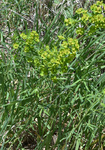
Euphorbiaceae: Euphorbia esula var. uralensis
Files
Family Name
Euphorbiaceae
Common Name
Leafy spurge
Description
Euphorbia esula var. uralensis is a perennial herbaceous plant, a variety of the invasive leafy spurge complex. It grows erect, typically 30–80 cm tall, with multiple branching stems arising from a deep, extensive root system. The stems are smooth and often glaucous (bluish green). Leaves are alternate, narrow, lanceolate to linear-lanceolate, 2–6 cm long and 5–15 mm wide, with entire margins and a somewhat waxy texture. This variety is distinguished by subtle morphological differences such as leaf shape and size compared to the nominal species, often adapted to more northern or central Eurasian habitats. Flowering occurs from late spring to early summer (May–July). The plant produces inconspicuous flowers surrounded by showy, yellowish-green bracts (cyathia), grouped in clusters at stem tips. The flowers are unisexual, but plants are monoecious. Fruit is a small three-lobed capsule containing seeds with elaiosomes that encourage ant dispersal. Leafy spurge is native to parts of Eurasia and introduced in North America, including South Dakota, where it is an aggressive invasive weed in pastures, rangelands, and disturbed areas.
Additional Notes
Primarily recognized as a troublesome invasive species, leafy spurge competes with native plants and forage species, reducing biodiversity and forage quality. It exudes a milky latex that is toxic to livestock and humans upon contact. Control efforts focus on mechanical, chemical, and biological methods.