

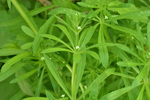
Rubiaceae: Galium aparine
Files
Family Name
Rubiaceae
Common Name
Cleavers, stickyweed, bedstraw
Native American Name
Lakota: waȟpé wáŋčaǧa hú bloká
Description
Galium aparine is an annual or biennial herbaceous plant growing from a fibrous root system and characterized by sprawling, weakly erect, square stems that can reach 30–100 cm in length. The stems and leaves are covered in tiny, hooked hairs, giving the plant a sticky or velcro-like feel, which helps it cling to other plants and surfaces for support. Leaves are arranged in whorls of six to eight, linear to lanceolate, 1–3 cm long and 2–5 mm wide, with rough margins. Flowering occurs from late spring through summer (May–August). Flowers are small and contain four sepals and petals. The sepals are green, small, triangular to lanceolate in shape, about 0.5 to 1 millimeter long. They form a tiny calyx cup at the base of the flower and often have fine hairs on their edges. The petals are white to greenish-white, and arranged like narrow, pointed stars. Each petal is about 1.5 to 3 millimeters long and about 2–3 mm wide, with a slightly notched or toothed tip, contributing to the star-like appearance of the flower. Flowers are bisexual, with four stamens and a pistil. Fruits are small schizocarps that separate into two mericarps covered with hooked hairs that stick to animals, clothing, and fur, aiding in seed dispersal. Cleavers are widespread in South Dakota in disturbed soils, woods, gardens, and along fences and roadsides.
Horticulture Notes
Seed Collection: Seeds mature in summer when fruits are dry and sticky; collect by brushing against plants or harvesting fruit clusters.
Germination: Seeds germinate best after cold stratification; sow in fall or early spring.
Vegetative Propagation: None; spreads primarily by seed attachment to animals and humans.
Soils: Prefers moist, well-drained soils but tolerates a wide range of soil types.
Light: Partial shade to full sun.
Water: Prefers moderate moisture but tolerates dry conditions once established.
Additional Notes
Cleavers or stickyweed has been used in herbal medicine for its diuretic and lymphatic system-supporting properties and used in teas for skin and urinary health. The plant has limited culinary uses as a wild green after cooking to reduce roughness. The plant is non-toxic but can be irritating due to its hooked hairs. Ecologically, it provides habitat and food for certain insects.