

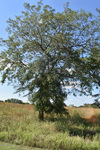
Fabaceae: Gleditsia triacanthos
Files
Family Name
Fabaceae
Common Name
Honey locust
Description
Gleditsia triacanthos is a deciduous tree known for its rapid growth, thorny branches, and distinctive compound leaves. It typically grows 15–25 meters tall, sometimes reaching up to 30 meters and has a broad, open crown. The bark is gray-brown and deeply furrowed. Branches bear large, branched thorns up to 20 cm long, though thornless cultivars exist. Leaves are pinnately or bipinnately compound, 20–40 cm long, with numerous small, ovate to lanceolate leaflets about 2–5 cm long and 1–2 cm wide. The tree is deciduous, shedding leaves in late fall. Flowering occurs in late spring (May–June). The flowers are small, greenish-yellow, and fragrant, arranged in loose, open racemes. Each flower is typically about 5–7 mm long. Each flower has four sepals and four petals. The sepals are small, green, and fused at the base, about 2–3 mm long, with lanceolate lobes. The petals are also small, about 3–5 mm long, yellow-green, and somewhat irregular in shape. The tree produces long, flattened pods 15–30 cm in length, containing several hard, brown seeds. Pods mature in fall and persist through winter. Honey locust is native to eastern South Dakota and the central United States. It is commonly used in landscaping and is widely naturalized throughout South Dakota, often found in floodplains, open woodlands, and along rivers.
Horticulture Notes
Seed Collection: Seeds mature in pods that dry in fall; scarification improves germination.
Germination: Seeds have hard coats requiring scarification or soaking before sowing; best sown in spring.
Vegetative Propagation: Possible through grafting or cuttings.
Soils: Tolerant of a wide range including heavy clay, loam, and sandy soils; prefers moist but well-drained soils.
Light: Full sun preferred.
Water: Drought tolerant once established but grows best with moderate moisture.
Additional Notes
Honey locust wood is valued for its hardness and durability, used in furniture and fence posts. Pods were historically used as fodder for livestock and occasionally consumed by people. The tree is popular as a shade and ornamental tree due to its filtered canopy. Native Americans used various parts of the tree for food, medicine, and tools.