

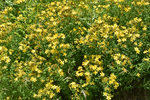
Clusiaceae: Hypericum perforatum
Files
Family Name
Clusiaceae (Hypericaceae)
Common Name
Common St. John’s wort
Description
Hypericum perforatum is a perennial herbaceous plant typically reaching heights of 30 to 90 cm. The plant has a fibrous root system and may spread by creeping rhizomes. Its stems are erect, square in cross-section, and usually glabrous or sparsely hairy with a reddish tint. The leaves are opposite, simple, narrow to oblong-lanceolate in shape, measuring approximately 1.5 to 4 cm long and 0.5 to 1.5 cm wide. Leaf margins are entire, and the leaf surfaces are smooth with characteristic tiny translucent glands that appear as perforations when held to light. Leaves are sessile and stipules are absent. The inflorescence usually forms in loose clusters (cymes) that bloom from late spring through summer (June–August). Flowers are about 1.5 to 2.5 cm in diameter, with five lanceolate to ovate sepals measuring 6 to 10 mm long and 2 to 4 mm wide, often marked by tiny black dots along the margins, and five bright yellow obovate petals approximately 1 to 1.5 cm long and 5 to 8 mm wide. The flowers contain numerous stamens, typically 30 to 60, grouped into three to five bundles. The pistil consists of three styles arising from a superior ovary, each ending with a stigma. The fruit is a small, ovoid to ellipsoid capsule approximately 5 to 8 mm long that splits open at maturity to release numerous tiny seeds Common St. John’s wort is native to Europe and parts of Asia, and is commonly found in South Dakota in disturbed areas, grasslands, roadsides, and open woods.
Horticulture Notes
Seed Collection: Mature seeds collect when capsules dry and split open in late summer.
Germination: Seeds usually germinate without special treatment; cold stratification can improve results.
Vegetative Propagation: Can be propagated by division or stem cuttings.
Soils: Adapted to a variety of well-drained soils, including sandy and rocky substrates.
Light: Prefers full sun but tolerates partial shade.
Water: Thrives in moderate moisture; tolerates drought once established.
Additional Notes
St. John’s Wort has a long history of traditional medicinal use, particularly for its antidepressant and wound-healing properties. It is widely used today in herbal supplements for mood support and has also been applied topically for skin ailments. However, it is considered an invasive species due to its rapid spread and potential to outcompete native vegetation. It is not recommended for native plantings.