

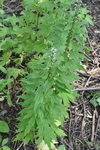
Lamiaceae: Leonurus cardiaca
Family Name
Lamiaceae
Common Name
Motherwort
Description
Leonurus cardiaca is a perennial herbaceous plant growing 0.5 to 1.5 meters tall. It has a fibrous root system with occasional short rhizomes. The stems are square in cross-section, erect, and typically covered with fine hairs. Leaves are opposite, simple, and palmately lobed with 3 to 5 deep lobes, measuring about 5 to 12 cm long and wide. Leaves are petiolate, with petioles approximately 2 to 5 cm long, and the leaf surfaces are sparsely to moderately hairy. The leaf margins are coarsely toothed. The inflorescence is a dense, interrupted spike of whorled flowers around the stem, flowering from mid to late summer (June–August). The calyx consists of five sepals fused into a tubular base about 4 to 7 mm long with five triangular-ovate, pointed lobes covered in fine hairs. The corolla is tubular, bilabiate, measuring about 8 to 12 mm long and 5 to 7 mm wide, with a hooded upper lip and a three-lobed lower lip; the petals are pink to purplish in color. Flowers have four stamens, two long and two short, and a superior ovary with a bifid style. The fruit is a schizocarp that splits into four nutlets. Motherwort is an introduced species native to Europe and parts of Asia. In South Dakota, it is found scattered in disturbed habitats, roadsides, and fields throughout the state.
Additional Notes
Motherwort has a history of medicinal use, especially for heart and nervous system ailments, and is cultivated as an herbal remedy. Ecologically, it attracts pollinators like bees.