

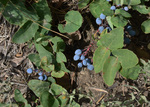
Berberidaceae: Mahonia repens
Files
Family Name
Berberidaceae
Common Name
Oregon grape, trailing mahonia
Native American Name
Lakota: húte zí
Description
Mahonia repens is a low-growing, evergreen shrub typically reaching 15 to 30 cm in height but spreading widely by trailing stems, forming dense mats. The plant has a woody root system and spreads by creeping stems that root at the nodes. Stems are wiry and covered with a smooth to slightly hairy bark. Leaves are alternate, pinnately compound with 5 to 9 leaflets, each leaflet measuring about 3 to 7 cm long and 1 to 3 cm wide. Leaflets are broadly elliptic to oblong with spiny-toothed margins and a leathery, glossy surface. Leaves have short petioles about 1 to 3 cm long. The inflorescence is a raceme of small, fragrant yellow flowers blooming from late spring to early summer (May–July). Each flower has six sepals and six petals arranged in two whorls; sepals are greenish yellow, about 4 to 6 mm long and 2 to 3 mm wide, ovate and spreading. The petals are bright yellow, about 6 to 8 mm long and 3 to 4 mm wide, obovate with rounded tips. Flowers have nine stamens with spurred filaments and a superior ovary. The fruit is a blue to dark purple berry about 6 to 10 mm in diameter with a waxy coating maturing in summer. In South Dakota, Oregon grape is native and found in forest understories, rocky slopes, and shaded areas primarily in the Black Hills region.
Synonym: Berberis repens
Horticulture Notes
Seed Collection: Collect berries when fully ripe in summer; seeds extracted after pulp removal.
Germination: Seeds require cold stratification; sow in well-drained soil in fall or early spring.
Vegetative Propagation: Easily propagated by stem cuttings or division.
Soils: Prefers well-drained, acidic to neutral soils.
Light: Thrives in partial to full shade but tolerates some sun.
Water: Prefers moderate moisture; tolerant of dry conditions once established.
Additional Notes
Oregon Grape is valued for its groundcover qualities, drought tolerance, and wildlife habitat. Traditionally used by Native peoples for medicinal purposes, including treatment of digestive and skin ailments. The berries are edible, though tart, and were sometimes used for food or dye.