

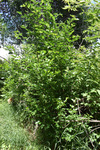
Moraceae: Morus alba
Family Name
Moraceae
Common Name
White mulberry
Native American Name
Lakota: čhaŋská
Description
Morus alba is a deciduous tree growing 10 to 20 meters tall, with a broad, spreading crown and rough, furrowed grayish-brown bark. Leaves are alternate, simple, and variable in shape—ovate to deeply lobed—measuring 5 to 15 cm long and 4 to 12 cm wide, with serrated or wavy margins and petioles 1 to 3 cm long. Leaf surface can be smooth or slightly hairy, sometimes variegated. . The species is dioecious or sometimes monoecious, with small greenish unisexual flowers arranged in catkin-like inflorescences. Male flowers occur in slender cylindrical catkins 3 to 7 cm long and 0.5 to 1 cm wide, each flower apetalous with usually 4 stamens bearing 2 to 3 mm long filaments and longitudinally dehiscent anthers that release pollen. Female flowers are grouped in shorter, compact catkins 1.5 to 4 cm long and 0.5 to 1 cm wide, consisting mainly of a single superior ovary with one locule and ovule, a short cylindrical style 1 to 2 mm long, and a bifid, papillose stigma. Both flower types have a perianth of 4 to 6 small, scale-like tepals under 1 mm long protecting reproductive parts. The fruit is a multiple fruit (syncarp), 2 to 3 cm long, resembling a blackberry and ripening to white, pink, red, or dark purple, composed of numerous small druplets. The fruits are edible and sweet. Native to China, White mulberry has been widely introduced worldwide, and has adapted well to the region’s climate. Its presence is most notable in the eastern and central parts of the state where human settlement and cultivation have introduced it widely.
Horticulture Notes
Seed Collection: Collect ripe fruits in late spring or early summer; extract seeds by maceration and washing.
Germination: Seeds require cold stratification; sow in fall or early spring.
Vegetative Propagation: Easily propagated by hardwood cuttings or grafting.
Soils: Adaptable to a wide range of soils, prefers well-drained fertile soils.
Light: Full sun to partial shade.
Water: Prefers moderate moisture but is drought tolerant once established.
Additional Notes
Cultivated primarily for its edible fruit and as a food source for silkworms in sericulture. The fruit is eaten fresh or processed. The wood is used for furniture and other purposes. This species is not recommended for native plantings.