

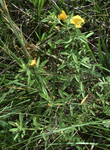
Onagraceae: Oenothera serrulata
Files
Family Name
Onagraceae
Common Name
Prairie evening primrose, serrate-leaved evening primrose
Description
Oenothera serrulata is a biennial or short-lived perennial herb growing from a deep taproot with an erect, 30 to 90 cm tall, branched stem often covered in fine hairs. The basal leaves are lanceolate to narrowly ovate, 5 to 15 cm long and 1 to 3 cm wide, with finely serrated (serrulate) margins, and short petioles. The stem leaves are smaller and more linear. Flowering occurs from late spring into mid-summer (May–July). The flowers are large and showy, born singly or in loose clusters on elongating stems, opening in the late afternoon or evening and lasting into the night. Each flower has four sepals, narrowly lanceolate and 10 to 15 mm long, which reflex as the flower opens. The corolla consists of four petals, bright yellow fading to orange with age, each 25 to 40 mm long and 10 to 15 mm wide, broadly obovate to spatulate in shape with a slightly notched apex. The flower contains eight stamens with slender filaments and conspicuous yellow anthers arranged around a single pistil. The ovary is superior with a slender style, about 15 to 20 mm long, terminating in a four-lobed stigma approximately 3 to 4 mm wide; the lobes are elongated and slightly papillose. The fruit is a slender capsule, 4 to 7 cm long, maturing in late summer, containing numerous small seeds. Serrate-leaved evening primrose is native to South Dakota, typically found in sandy or rocky soils of prairies, open woodlands, and disturbed sites across the central and western parts of the state.
Horticulture Notes
Seed Collection: Collect mature, dry seed capsules in late summer.
Germination: Requires cold stratification; sow seeds in well-drained soil in fall or early spring.
Vegetative Propagation: Primarily by seed; division less common.
Soils: Prefers well-drained sandy or rocky soils.
Light: Full sun.
Water: Drought tolerant, prefers moderate moisture but thrives in dry conditions.
Additional Notes
Serrate-leaved evening primrose is valued for its ornamental bright yellow flowers and its role in supporting nocturnal pollinators such as moths. It has been used traditionally by Native American peoples for medicinal purposes, including treatments for skin irritations and digestive issues. The seeds and roots contain oils that have been explored for nutritional and therapeutic applications.