

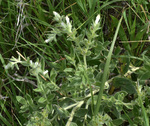
Boraginaceae: Onosmodium bejariense
Files
Family Name
Boraginaceae
Common Name
Western false gromwell
Native American Name
Lakota: šúŋkačhaŋkȟahúiphi ye
Description
Onosmodium bejariense is a perennial herbaceous plant with a woody base, growing 30 to 90 cm tall with erect, branched stems densely covered in coarse, spreading hairs that give a rough texture. The alternate leaves are lanceolate to narrowly ovate, 5 to 15 cm long and 1 to 4 cm wide, with entire to slightly wavy margins, short petioles and a rough, hairy surface. Flowering occurs in mid-summer (May–July). The flowers are born in terminal and axillary cymes. Each flower has five sepals fused at the base, each sepal about 5–8 mm long, narrowly lanceolate and hairy forming a calyx tube about 6 to 10 mm long with pointed lobes. The corolla consists of five white petals fused into a tubular shape 10 to 15 mm long and 4 to 6 mm wide. with 5 hairy, green to yellow-tinged, triangular lobes at the tip that close the mouth of the tube. A long white style projects from the tube and remains long after the petals wilt away. The flower contains five stamens epipetalous (attached near the base of the corolla tube), with slender filaments and yellow anthers enclosed within the tube. The pistil has a superior ovary with a single style approximately 6 to 8 mm long, extending beyond the stamens. And terminating in a bifid stigma with rounded lobes about 1 to 2 mm wide. Fruits develop from August through September as four brown, smooth, slightly glossy nutlets, each about 3 to 5 mm long. Western false gromwell is native to South Dakota, typically found in sandy or rocky prairies, open woodlands, and well-drained upland sites across much of the state.
Horticulture Notes
Seed Collection: Collect mature nutlets when dry, late summer.
Germination: Seeds may require cold stratification; sow in well-drained soil in fall or early spring.
Vegetative Propagation: Primarily from seed; vegetative reproduction uncommon.
Soils: Prefers well-drained, often sandy or rocky soils.
Light: Full sun to partial shade.
Water: Adapted to moderate to dry conditions.
Additional Notes
Western false gromwell provides nectar for native bees and other pollinators.