

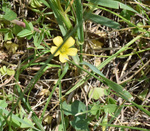
Oxalidaceae: Oxalis dillenii
Files
Family Name
Oxalidaceae
Common Name
Southern Wood-sorrel
Description
Oxalis dillenii is a small annual herbaceous plant growing 10 to 30 cm tall with slender, branching stems that are often slightly hairy. The trifoliate leaves are composed of three heart-shaped leaflets, each 1 to 2 cm long and 1 to 1.5 cm wide, with a distinct fold along the midrib and a bright green color. The flowers are borne singly or in small clusters on slender stalks above the foliage, blooming from May through October. Each flower has five green, lanceolate sepals about 4 to 6 mm long and 1.5 to 2 mm wide. The corolla consists of five bright yellow petals, each 8 to 12 mm long and 4 to 6 mm wide, obovate in shape with a rounded apex. The flower contains ten stamens with filaments of varying lengths and yellow anthers arranged around a superior ovary. The pistil has a single style approximately 5 to 7 mm long, terminating in a capitate (head-shaped) stigma about 1 to 1.5 mm wide. The fruit is a cylindrical capsule 10 to 15 mm long and 2 to 3 mm wide, developing after flowering from June through October; it dehisces explosively to release numerous small seeds. Southern Wood-sorrel is considered a native weed in South Dakota. It is difficult to distinguish from Oxalis stricta without a microscopic analysis of mature specimens. Oxalis dillenii has short, dense appressed hairs on the stems. The unbranched flower clusters typically have two flower buds, and the fruits of erect capsules are attached to bent or spreading stalks.
Horticulture Notes
Seed Collection: Mature capsules collected in summer to early fall when dry and ready to burst.
Germination: Seeds germinate readily without special treatment, prefer light for germination.
Vegetative Propagation: Primarily by seed.
Soils: Adaptable to a wide range of soils, prefers well-drained soils.
Light: Full sun to partial shade.
Water: Moderate moisture; tolerates dry conditions once established.
Additional Notes
Oxalis dillenii is primarily considered a weed but has edible leaves with a tangy, lemon-like flavor due to oxalic acid, used in small amounts as a flavoring or salad green. It also provides nectar for bees and other pollinators.