

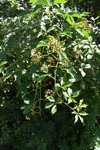
Vitaceae: Parthenocissus vitacea
Files
Family Name
Vitaceae
Common Name
Woodbine, grape woodbine
Native American Name
Lakota: čhaŋíyuwi iyéčheča
Description
Parthenocissus vitacea is a vigorous, deciduous woody vine capable of climbing 10 to 20 meters high by means of tendrils that allow it to attach to surfaces such as trees, rocks, or buildings. The root system consists of a robust, woody perennial base from which the climbing stems arise annually. The leaves are alternate and petiolate, with petioles 5 to 12 cm long. Each leaf is palmately compound with five leaflets, each leaflet ovate to lanceolate, 5 to 12 cm long and 3 to 7 cm wide, with serrate margins and a glossy dark green upper surface that turns reddish-purple in fall. The flowers are small, greenish, and inconspicuous, arranged in loose, branched panicles blooming from June through August. Each flower has five sepals that are lanceolate to ovate, 1.5 to 3 mm long and about 1 mm wide. The corolla consists of five tiny petals about 2 to 4 mm long and 1 to 1.5 mm wide, broadly ovate with a rounded apex. There are five stamens with short filaments and yellow anthers. The pistil has a superior ovary with a slender style about 3 to 4 mm long, ending in a small, bifid stigma. The fruit develops from August through October, maturing into small, globose berries approximately 6 to 8 mm in diameter, dark blue to black when ripe. Woodbine is native to South Dakota, commonly found climbing on trees, fence lines, and rocky bluffs in woodland edges and riparian zones throughout the state.
Horticulture Notes
Seed Collection: Harvest ripe berries in late summer or early fall; remove pulp to collect seeds.
Germination: Seeds require scarification and 60 days of cold-moist stratification for best germination rates; sow in fall or treated seeds in spring.
Vegetative Propagation: Can be propagated by hardwood stem cuttings.
Soils: Adaptable to various soil types, prefers moist, well-drained soils.
Light: Thrives in full sun to shade.
Water: Prefers moderate moisture; tolerates occasional drought.
Additional Notes
Woodbine is valued for its ornamental climbing habit and vibrant fall foliage. It provides cover and food for birds and other wildlife. The vine is sometimes used for erosion control on slopes and in restoration plantings.