

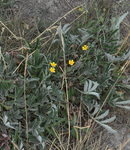
Rosaceae: Potentilla hippiana
Files
Family Name
Rosaceae
Common Name
Hipp's cinquefoil
Description
Potentilla hippiana is a perennial herbaceous plant growing 15 to 60 cm tall growing from a thick, woody rootstock. Its slender, erect stems are often hairy. The alternate, compound leaves typically have five to seven ovate to lanceolate leaflets, each 1.5 to 4 cm long and 0.5 to 2 cm wide, with finely serrated margins and a petiole 2 to 6 cm long. The upper leaf surface is medium green, mostly smooth to slightly hairy, while the lower surface is paler and covered with fine hairs, giving it a soft texture. The inflorescence is a loose cyme of bright yellow flowers that bloom from June through August. The calyx consists of five lanceolate sepals, 4 to 7 mm long and 1.5 to 3 mm wide, often hairy along the edges with pointed tips that curve slightly outward, enclosing the flower before it opens. Each flower has five broadly ovate petals, about 8 to 15 mm long and 5 to 12 mm wide. Numerous stamens with slender filaments, 3 to 5 mm long, and bright yellow anthers surround the pistils, which number around 20 to 40 per flower, each 3 to 4 mm long with slender styles and small rounded stigmas. Fruit matures from August through September as an aggregate of small achenes, 2 to 3 mm long, tightly clustered after fertilization. Native to South Dakota, Hipp's cinquefoil is commonly found in dry prairies, open rocky slopes, and well-drained soils, especially in the western and central parts of the state.
Horticulture Notes
Seed Collection: Collect mature achenes in late summer.
Germination: Seeds generally require a cold-moist stratification period of 60–120 days to break dormancy, or they should be sown outdoors in the fall. Seeds germinate best in light, requiring only surface sowing (lightly pressed into the soil) and consistent moisture.
Vegetative Propagation: Possible by division or cuttings.
Soils: Prefers well-drained sandy or rocky soils.
Light: Full sun to partial shade.
Water: Prefers moderate moisture; tolerates some drought.
Additional Notes
Hipp's cinquefoil provides early-season nectar for pollinators and contributes to soil stabilization in dry, rocky habitats. It is also valued in native plant gardens for its drought tolerance and bright yellow flowers.