

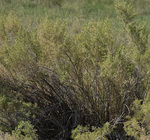
Chenopodiaceae: Sarcobatus vermiculatus
Family Name
Chenopodiaceae (Sarcobataceae)
Common Name
Greasewood
Description
Sarcobatus vermiculatus is a deciduous shrub with spiny branches, growing 1 to 3 meters tall, from an extensive, fibrous root system, adapted to saline and alkaline soils, producing root sprouts and rhizomes, allowing it to form dense clonal thickets. The plant blooms from May through July. Leaves are alternate, simple, fleshy, and scale-like, 1 to 3 cm long, narrowly ovate to linear, green to gray green in color. The inflorescence consists of dense, spike-like clusters of small, inconspicuous flowers 3 to 5 mm long. Each flower has no true petals or sepals; instead, it is subtended by small, free bracts. Male and female flowers are borne on separate plants (dioecious). Male flowers contain several stamens—typically 5 to 8—with filaments inserted opposite the bracts; anthers are small, about 1 mm long. Female flowers have a single pistil with one carpel, a sessile ovary approximately 1 to 2 mm long, a short style, and a small stigma. The fruit is a small, hard, winged achene about 3 to 4 mm in diameter that matures from August to September. This plant is native to South Dakota, occurring primarily in saline and alkaline flats, playas, and desert shrublands, mostly in the western parts of the state.
Horticulture Notes
Seed Collection: Late summer. Remove seed cases (pericarp) to improve results.
Germination: Seeds germinate best in moist, saline soils. Germination is highest at alternating temperatures, such as
Vegetative Propagation: By root sprouts.
Soils: Prefers saline, alkaline, and well-drained soils
Light: Full sun
Water: Low to moderate moisture, drought tolerant
Additional Notes
Greasewood is important for stabilizing saline soils and providing habitat for wildlife in arid and semi-arid regions. It is sometimes used for erosion control and as forage for livestock, though its high salt content limits its palatability.