

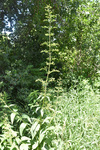
Scrophulariaceae : Scrophularia lanceolata
Files
Family Name
Scrophulariaceae
Common Name
Lanceleaf figwort
Description
Scrophularia lanceolata is a perennial herb growing 30 to 90 cm tall from a fibrous root system. The stems are erect, square in cross-section, and slightly hairy to glabrous. Leaves are opposite, simple, and lanceolate to ovate-lanceolate, 5 to 12 cm long and 2 to 5 cm wide, with serrated margins and a pointed tip, dark green above and lighter beneath. The plant flowers from June through August. The inflorescence is a terminal or axillary cyme with small tubular flowers about 10 to 15 mm long. Each flower has five free, greenish sepals that are ovate and about 2 to 3 mm long, and five free, reddish to purplish petals fused at the base forming a tubular bilabiate, corolla with spreading lobes. The upper lip 2-lobed and the lower lip shorter with 3 lobes. There are four stamens per flower, with filaments about 6 to 8 mm long inserted inside the corolla tube and yellow anthers approximately 2 to 3 mm long. The pistil is single with one locule, about 5 to 7 mm long, a style 3 to 4 mm long, and a bilobed stigma. The fruit is a dry, ovoid capsule about 8 to 12 mm long that ripens in late summer and splits open to release numerous small seeds. Lanceleaf figwort is native to South Dakota, occurring in open woods, prairies, and along roadsides throughout much of the state.
Horticulture Notes
Seed collection: Typically occurs in late summer, from August through September, when capsules mature.
Germination: Seeds germinate readily when sown in moist, well-drained soil.
Propagation: Vegetative propagation is possible through root division.
Soils: Prefers well-drained, often rocky or sandy soils.
Light: Thrives in full sun to partial shade.
Water: Prefers moderate moisture.
Additional Notes
Lanceleaf figwort is valued for its role in native plant gardens and natural landscapes, attracting pollinators such as bees and butterflies.