

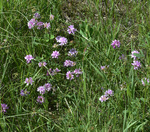
Fabaceae: Securigera varia
Files
Family Name
Fabaceae
Common Name
Crownvetch
Description
Securigera varia is a perennial herbaceous vine or groundcover growing from a fibrous root system. The stems are slender, sprawling to trailing, smooth or slightly hairy, and can reach up to 1 to 2 meters long, often forming dense mats. The leaves are alternate and pinnately compound with 15 to 25 leaflets. Each leaflet is oblong to lanceolate, measuring 1 to 3 cm long and 0.5 to 1.5 cm wide, often with a small tooth-like point at the tip. The upper leaf surface is dark green and glabrous (smooth), while the lower surface is lighter green and may have fine hairs. Leaf margins are entire or slightly serrated. Petioles are short, typically 1 to 3 cm long, supporting the leaflets in a feather-like arrangement. Plants bloom from June through September. The inflorescence is a terminal umbel with 15 to 30 pink to lavender flowers, each about 15 to 20 mm in diameter. Each flower has five free, small green sepals that are ovate and about 2 to 3 mm long, and five free petals forming the typical papilionaceous (butterfly-like) shape of legumes: a large banner petal (10–15 mm), two wing petals (8–12 mm), and two keel petals (7–10 mm) fused at the base. There are ten stamens per flower, nine filaments fused into a tube and one free (diadelphous), and yellow anthers about 1 to 2 mm long. The pistil is single with one carpel forming a simple ovary about 5 to 7 mm long, a style about 6 to 8 mm long, and a small stigma. The fruit is a slender, cylindrical legume pod about 3 to 6 cm long that ripens from August to October and contains several seeds. . Crownvetch is native to Europe and Asia but has become naturalized in South Dakota, commonly found in disturbed sites, open fields, roadsides, and is used as a groundcover in erosion control plantings, primarily in the eastern parts of the state.
Additional Notes
Crownvetch is primarily used for soil erosion control and ground cover due to its dense, mat-forming growth and nitrogen-fixing ability. It provides forage for pollinators but is generally considered invasive in some areas of the state.