

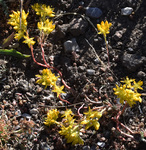
Crassulaceae: Sedum lanceolatum
Files
Family Name
Crassulaceae
Common Name
Lanceleaf stonecrop
Description
Sedum lanceolatum is a perennial succulent herb growing 10 to 30 cm tall from a shallow, fibrous root system. The stems are erect to ascending, smooth, and often reddish or green. Leaves are alternate, simple, lanceolate to narrowly ovate, 1 to 4 cm long and 0.5 to 1.5 cm wide, with entire margins. The upper leaf surface is smooth and bright green, sometimes with a waxy coating, while the lower surface is lighter and glabrous. Petioles are short or nearly absent, with leaves often sessile or clasping the stem. The plant flowers from June through August. The inflorescence is a terminal cyme bearing star-shaped flowers about 10 to 15 mm in diameter. Each flower has five free, greenish, lanceolate sepals, 2 to 3 mm long, and five free, yellow petals that are lanceolate, 7 to 10 mm long. There are ten stamens per flower, with filaments about 5 to 7 mm long inserted at the base of the petals, and yellow anthers about 1 to 2 mm long. The pistil is single with five fused carpels forming a compound ovary with five locules, about 3 to 4 mm long, a style about 2 to 3 mm long, and a small, capitate stigma. The fruit is a five-chambered capsule about 5 to 7 mm long that ripens from July to September and splits open to release numerous tiny seeds. Lanceleaf stonecrop is native to South Dakota, occurring in rocky slopes, scree, alpine meadows, and open montane habitats, mostly in the western mountainous regions of the state.
Horticulture Notes
Seed collection: Typically from August to September, when follicles mature and split.
Germination: Seeds require well-drained, gritty soil and moderate moisture; stratification may improve germination. Fall planting is recommended.
Propagation: Also propagated by leaf or stem cuttings.
Soils: Prefers well-drained, rocky or sandy soils.
Light: Full sun is essential for healthy growth.
Water: Very drought tolerant; avoid overwatering.
Additional Notes
Lanceleaf stonecrop is valued for its drought tolerance, attractive succulent foliage and flowers, and is used in rock gardens and xeriscaping. It provides nectar for pollinators and stabilizes rocky soils.