

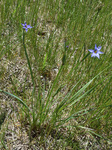
Iridaceae: Sisyrinchium montanum
Files
Family Name
Iridaceae
Common Name
Mountain blue-eyed grass
Description
Sisyrinchium montanum is a perennial herb growing 15 to 40 cm tall from a fibrous root system with short rhizomes. The stems are winged, slender, erect, and smooth to slightly rough. Leaves are narrow, grass-like, linear to lanceolate, typically 10 to 25 cm long and 2 to 5 mm wide, with entire margins. The upper and lower leaf surfaces are smooth and bright green. The plant blooms from May through July. The inflorescence consists of solitary or small clusters of star-shaped flowers about 15 to 25 mm in diameter, initially enclosed in ovate to lanceolate bracts that are smooth in texture, and measure 10 to 20 mm long. The spathe bracts are positioned opposite each other at the base of the flower cluster and often have a slightly membranous margin. Each flower has six tepals that are pale blue to violet with a yellow base. Tepals measure about 7 to 12 mm long and 3 to 5 mm wide, with a smooth texture and entire margins. There are six stamens per flower, with filaments about 5 to 7 mm long and yellow anthers about 2 to 3 mm long. The pistil consists of three fused carpels forming a compound ovary with three locules, a style about 5 to 6 mm long, and a trifid stigma. The fruit is a 3-lobed capsule about 6 to 8 mm long that ripens from July to August, releasing numerous small seeds. Mountain blue-eyed grass is native to South Dakota, commonly found in moist meadows, open woods, and along streambanks, mostly in the northern and western parts of the state.
Horticulture Notes
Seed collection: From July to August when seed capsules mature.
Germination: Seeds germinate best in well-drained soil with moderate moisture and exposure to light. Fall planting is recommended.
Propagation: Division of clumps.
Soils: Prefers moist, well-drained sandy or loamy soils.
Light: Thrives in full sun to partial shade.
Water: Prefers moderate moisture but tolerates short periods of drought.
Additional Notes
Mountain blue-eyed grass is valued for its delicate blooms and is used in native plant gardens and natural area restorations.