

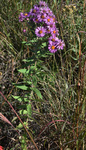
Asteraceae: Symphyotrichum novae-angliae
Files
Family Name
Asteraceae
Common Name
New England aster
Description
Symphyotrichum novae-angliae is a perennial, herbaceous plant with a fibrous root system and short, stout rhizomes, forming upright clumps rather than spreading colonies. Mature plants typically reach 90–180 cm in height. Stems are erect, stout, and densely covered with short, stiff hairs, often with a reddish tint. Leaves are alternate, simple, lanceolate to oblong, 5–15 cm long and 1–3 cm wide, with entire to slightly toothed margins and pointed tips. Basal leaves have short petioles and may be withered by flowering time; stem leaves are sessile and clasp the stem with an auriculate (ear-like) base. Leaf surfaces are medium to dark green, rough and hairy above and below, giving the foliage a coarse texture. Flowering occurs from August to October, with inflorescences forming large, showy, branched panicles up to 30 cm wide, each with numerous daisy-like flower heads. Each head is subtended by a cylindric involucre, 7–10 mm long, with several rows of overlapping, green to purplish, lanceolate phyllaries with translucent margins. Each head contains 30–60 violet to purple (rarely pink or white) ray florets (petals), each 10–20 mm long and 1–2 mm wide. The disc florets are numerous (30–50 per head), tubular, 5–7 mm long, yellow at anthesis (turning reddish-brown with age), with five small lobes at the tip. Stamens are five per disc floret, with yellow anthers about 1.5 mm long, forming a tube around the style. The pistil consists of a single compound ovary per floret, with a slender style about 3 mm long and a bifid stigma. The fruit is a small, dry, ribbed cypsela (achene), 2–3 mm long, brown when mature in autumn (September through November); each is topped with a tawny to white, hair-like pappus 4–6 mm long. New England aster is native to South Dakota and is found throughout the state in moist prairies, meadows, stream banks, roadside ditches, and open woods, typically in moderately moist, well-drained soils under full sun to partial shade.
Synonym: Aster novae-angliae
Horticulture Notes
Seed collection: Collect seeds from heads in late fall (October–November) when achenes are mature and readily detach.
Germination: Seeds require light for germination; sow on the soil surface. Cold, moist stratification (30–60 days) can improve germination rates.
Vegetative propagation: Propagated by division of clumps or rhizomes in spring or fall.
Soils: Prefers moderately moist, well-drained soils but adapts to a range, including clay and sandy loams.
Light: Requires full sun for best flowering; tolerates partial shade.
Water: Prefers moist to moderately moist soils; moderately drought-tolerant once established but grows best with regular moisture.
Additional Notes
New England aster is highly valued for supporting pollinators such as bees and butterflies, particularly in late summer and fall. It is a popular choice for native plant gardens, prairie restorations, and naturalized landscapes because of its large, showy blooms. The plant also provides seeds and shelter for birds and small mammals. It tolerates a range of soils and moisture levels but prefers moist, well-drained conditions.