

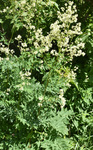
Ranunculaceae: Thalictrum dasycarpum
Files
Family Name
Ranunculaceae
Common Name
Purple meadow-rue
Native American Name
Lakota: wazímna, wazímniŋkpa
Description
Thalictrum dasycarpum is a perennial, herbaceous plant with a fibrous root system and short, thick rhizomes, forming loose clumps. Mature plants typically reach 60–200 cm in height. Stems are erect, hollow, round, often branching above, and smooth or sometimes finely grooved, usually glabrous but occasionally sparsely hairy near the nodes. Leaves are alternate, compound, and 2- to 3-ternate (divided two or three times), with the largest lower leaves up to 40 cm long and 30 cm wide, each leaflet ovate to rhombic, 2–6 cm long and 1–4 cm wide, with 3-lobed or coarsely toothed margins; upper surfaces are medium green and smooth, lower surfaces are paler and sometimes slightly hairy along the veins. Leaflets are attached by slender petiolules 0.5–2 cm long; petioles are present, 4–15 cm long, especially on basal and lower leaves. Flowering occurs from May to July, with inflorescences forming large, loose, pyramidal panicles up to 30 cm long, composed of numerous small, apetalous flowers. Each flower has four to six greenish-white sepals, 3–5 mm long and 1–2 mm wide, that are oblong, free, and soon deciduous. True petals are absent. Stamens are numerous (20–50 per flower), with long, slender white to purple filaments and yellow anthers 2–3 mm long, extending well beyond the sepals and giving the flowers a feathery appearance; pistils are also numerous (10–20 per flower), each with a slender style 3–4 mm long and a stigma that is slightly expanded and papillose. The fruit is a small, dry, ovoid to ellipsoid achene, 3–4 mm long, covered with dense, soft hairs (hence the species name, “dasycarpum” meaning “hairy fruit”), maturing from June to August. Purple meadow-rue is native to South Dakota and is common throughout the state in moist prairies, open woodlands, stream banks, wet meadows, and marshy lowlands, especially in rich, moist, well-drained soils in full sun to partial shade.
Horticulture Notes
Seed collection: Collect achenes in summer (June–August) when fruits are dry and easily detach from the plant.
Germination: Seeds require a period of cold, moist stratification (60–90 days) before sowing for best germination. Fall planting works well.
Vegetative: Propagated by division of clumps or rhizomes in early spring or fall.
Soils: Prefers moist, rich, well-drained soils; tolerates some seasonal flooding but not prolonged drought.
Light: Thrives in full sun to partial shade.
Water: Prefers consistently moist conditions; tolerates seasonal wetness but not extended dry periods.
Additional Notes
Purple meadow-rue is valued horticulturally for its elegant, feathery foliage and unique, airy flower clusters, which add vertical interest and delicate texture to native plant gardens, wetland restorations, and naturalized landscapes. Ecologically, it provides habitat and shelter for insects and small wildlife, and its early-season flowers are important for native pollinators, especially flies and bees.