

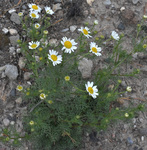
Asteraceae: Tripleurospermum perforatum
Files
Family Name
Asteraceae
Common Name
Scentless chamomile
Description
Tripleurospermum perforatum is a perennial, herbaceous plant with a fibrous root system and creeping rhizomes, often forming dense mats. Mature plants typically reach 20–80 cm in height. Stems are erect, branched, slender, and green to reddish, often sparsely hairy or glabrous. Leaves are alternate, pinnately divided, and fern-like, 5–15 cm long, with numerous small, narrow, linear to lanceolate lobes; leaves are bright green, with translucent oil glands visible as tiny dots when held to light (hence “perforatum”). Petioles are short or absent. Flowering occurs from June to September, with inflorescences forming solitary or few-flowered terminal heads resembling small daisies, 2–3 cm in diameter. Each flower head has a prominent involucre composed of several overlapping, green bracts (phyllaries) that are lanceolate to ovate, 8–12 mm long and 3–5 mm wide, with membranous margins. The flower head contains numerous white ray florets (20–30), each 6–12 mm long and 1–2 mm wide, and a dense central disc of yellow disc florets (30–50), tubular and 3–5 mm long with five small lobes at the apex. Stamens number five per disc floret, with yellow anthers about 1 mm long forming a tube around the style. The pistil is single with a slender style and bifid stigma. The fruit is a small, dry, ribbed achene (cypsela), 2–3 mm long, with three distinctive ribs and two resinous glands, maturing from August to October. Scentless chamomile is introduced in South Dakota, native to Eurasia, and found in disturbed sites such as fields, roadsides, pastures, and waste areas, thriving in well-drained, sandy to loamy soils under full sun.
Synonym: Matricaria perforata
Horticulture Notes
Scentless chamomile is generally considered a weed with little horticultural value due to its invasive tendencies and competition with crops and native plants. Ecologically, it provides nectar for a variety of generalist pollinators but can reduce native plant diversity. It has no strong scent, distinguishing it from true chamomile.