

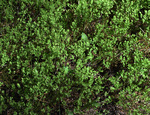
Ericaceae: Vaccinium scoparium
Files
Family Name
Ericaceae
Common Name
Grouse whortleberry, littleleaf huckleberry
Native American Name
Lakota: háza
Description
Vaccinium scoparium is a perennial, deciduous shrub with a shallow, fibrous root system and no rhizomes or tubers. Mature plants typically reach 10–60 cm in height. Stems are slender, erect to spreading, often forming dense, low mats or thickets. Leaves are alternate, simple, broadly ovate to elliptical, 0.5–2 cm long and 0.3–1 cm wide, with finely serrated margins and an acute tip. The upper leaf surface is dark green and glabrous or sparsely hairy, while the lower surface is paler and sometimes glaucous. Petioles are short, 1–3 mm long. Flowering occurs from May to July, with inflorescences forming small clusters or solitary nodding, bell-shaped flowers 4–7 mm long. Flowers have five fused sepals forming a small green calyx 1–1.5 mm long, and five fused petals forming a white to pale pink, urn-shaped corolla 3–6 mm long with a slightly flared mouth. Stamens number ten, with filaments often hairy near the base and anthers with terminal pores for buzz-pollination. The pistil consists of a single ovary with a slender style and small stigma. The fruit is a round, fleshy berry, 5–8 mm in diameter, dark blue to black with a smooth, glossy skin, maturing from July to September. Grouse whortleberry is native to South Dakota’s Black Hills and western regions, typically found in montane forests, subalpine meadows, and rocky slopes, favoring acidic, well-drained soils under partial shade.
Horticulture Notes
Seed collection: Collect ripe berries in mid to late summer (July–September); extract seeds by maceration and washing.
Germination: Seeds require cold, moist stratification (90–120 days) to break dormancy; sow in fall or stratify and sow in spring. Growing in pots for 1-3 years before transplanting is recommended.
Vegetative propagation: Propagated by softwood cuttings or layering; root suckers may occasionally form.
Soils: Prefers acidic, well-drained soils rich in organic matter; tolerates rocky, sandy substrates.
Light: Thrives in partial shade to full sun, with best fruiting in dappled light.
Water: Prefers moist soils; tolerates moderate drought but not prolonged dryness or waterlogging.
Additional Notes
Grouseberry is valued horticulturally for its edible berries and as an attractive low-growing native shrub suited for naturalized plantings and wildlife gardens. Ecologically, it provides important food for birds, small mammals, and bears, and its flowers support native pollinators. The fruit is harvested traditionally by indigenous peoples and wild foragers.