

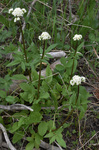
Valerianaceae: Valeriana occidentalis
Files
Family Name
Valerianaceae (Caprifoliaceae)
Common Name
Western valerian
Description
Valeriana occidentalis is a perennial, herbaceous plant with a fibrous root system and short, thick rhizomes, forming loose clumps. Mature plants typically reach 30–90 cm in height. Stems are erect, branched or unbranched, round, and smooth to sparsely hairy. Leaves are opposite or whorled, compound, ternate to pinnate, with leaflets ovate to lanceolate, 2–8 cm long and 1–3 cm wide, with serrated margins and pointed tips. Leaf surfaces are medium green, with both surfaces glabrous or sparsely hairy. Petioles are present and range from 2–8 cm in length. Flowering occurs from June to August, with inflorescences forming dense, compound cymes up to 10 cm wide, bearing numerous small, tubular, funnel-shaped flowers about 5–8 mm long. Flowers have five greenish-white sepals, 1–2 mm long, free and lanceolate, and five fused petals forming a corolla tube 4–7 mm long with five spreading lobes. Stamens number five, inserted on the corolla tube, with yellow anthers approximately 1 mm long. The pistil consists of a single ovary with a slender style and a capitate stigma. The fruit is a small, dry, ribbed achene, 2–3 mm long, maturing from July to September. Western valerian is native to South Dakota, occurring mainly the Black Hills in montane meadows, open forests, and moist slopes, favoring well-drained, moderately rich soils under full sun to partial shade.
Horticulture Notes
Seed collection: Collect seeds from mature flower heads in late summer (July–September) when achenes are dry and easily detached.
Germination: Seeds require cold, moist stratification (30–60 days) for best germination; sow in spring or fall.
Vegetative propagation: Propagated by division of rhizomes or basal clumps in spring.
Soils: Prefers moist, well-drained, moderately rich soils; tolerates loam and rocky substrates.
Light: Thrives in full sun to partial shade.
Water: Prefers moderate moisture; tolerates short dry periods but not prolonged drought or waterlogging.
Additional Notes
Western valerian is valued horticulturally for its delicate, fragrant flowers and as a native wildflower suited to naturalistic gardens and restoration projects. Ecologically, it provides nectar for native bees and butterflies and serves as a component of montane meadow plant communities.