

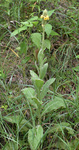
Scrophulariaceae: Verbascum thapsus
Files
Family Name
Scrophulariaceae
Common Name
Common mullein
Native American Name
Lakota: apé hiŋšmá
Description
Verbascum thapsus is a biennial herbaceous plant with a deep taproot. In the first year, it forms a dense basal rosette of large, soft, woolly leaves; in the second year, it produces a tall, erect flowering stem reaching 1–2.5 meters in height. Stems are stout, covered densely with soft, woolly hairs, giving a silvery-gray appearance. Leaves are alternate, simple, broadly ovate to lanceolate, 10–40 cm long and 5–20 cm wide, with entire or slightly wavy margins and acute to rounded tips. Both leaf surfaces are densely covered with soft, velvety hairs. Petioles are short or absent in basal leaves and longer in stem leaves. Flowering occurs from June to September, with inflorescences forming a large, dense, spike-like raceme up to 60 cm long, bearing numerous yellow, five-petaled flowers. The calyx consists of five green, ovate sepals, 7–10 mm long, free and slightly hairy. The corolla has five bright yellow petals, 15–25 mm long and 10–15 mm wide, fused at the base and spreading widely. Each flower has five stamens with filaments covered in purple glandular hairs and yellow anthers about 3–5 mm long. The pistil is single, with a superior ovary, slender style, and bifid stigma. The fruit is a small, ovoid to ellipsoid capsule, 4–6 mm long, containing numerous tiny seeds, maturing from August to October. Common mullein is introduced in South Dakota, native to Europe and Asia, and commonly found in disturbed sites, roadsides, fields, and waste areas, thriving in well-drained, sandy to loamy soils under full sun.
Horticulture Notes
Common mullein is valued horticulturally for its architectural form and bright yellow flowers, often used in ornamental gardens and naturalized plantings. Ecologically, it provides nectar for bees and butterflies but can be invasive and outcompete native vegetation. The plant has a long history of traditional medicinal uses, especially as a remedy for respiratory ailments. This plant is an introduced weed and is not appropriate for native plantings.