

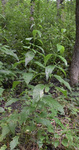
Verbenaceae: Verbena urticifolia
Files
Family Name
Verbenaceae
Common Name
White vervain, white verbena
Description
Verbena urticifolia is a perennial, herbaceous plant with a fibrous root system and short rhizomes, forming loose clumps. Mature plants typically reach 30–90 cm in height. Stems are erect, slender, square in cross-section, branched, and covered with spreading, rough hairs. Leaves are opposite, simple, ovate to lanceolate, 5–12 cm long and 2–5 cm wide, with serrated margins and pointed tips; both leaf surfaces are rough-hairy, especially along the veins. Petioles are present, 1–4 cm long. Flowering occurs from July to September, with inflorescences forming slender, spike-like racemes 5–15 cm long, bearing many small, white to pale lavender flowers. Each flower has a calyx with five green, lanceolate sepals about 3–5 mm long, fused at the base, and a corolla with five fused petals forming a tubular, two-lipped flower about 5–7 mm long. Stamens number four, didynamous (two long and two short), with white filaments and yellow anthers. The pistil consists of a single ovary with a slender style and bifid stigma. The fruit is a four-lobed schizocarp that splits into four one-seeded nutlets, each about 2 to 3 mm long, maturing from August to October. White vervain is native to South Dakota , found in eastern and southern counties. in moist to mesic woodlands, thickets, roadsides, and shaded areas, often in rich, well-drained soils under partial to full shade.
Horticulture Notes
Seed collection: Collect seeds from mature fruiting bodies in late summer to early fall (August–October) when nutlets are dry.
Germination: Seeds germinate readily without stratification; sow on or near the soil surface.
Vegetative propagation: Propagated by division or cuttings.
Soils: Prefers rich, well-drained soils; tolerates a range of soil types.
Light: Thrives in partial to full shade.
Water: Prefers moderate moisture; tolerates occasional dry periods but not prolonged drought.
Additional Notes
White vervain is valued horticulturally for its delicate, airy flower spikes and as a native wildflower suitable for shade gardens and naturalistic plantings. Ecologically, it provides nectar for native bees and butterflies and serves as a host plant for some butterfly larvae. It contributes to native plant diversity and is occasionally used in woodland and shade gardens.