

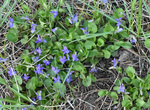
Violaceae: Viola adunca
Files
Family Name
Violaceae
Common Name
Early blue violet, hookedspur violet
Native American Name
Lakota: waȟpé tȟó čík’ala
Description
Viola adunca is a perennial, herbaceous plant with a fibrous root system and short rhizomes, forming loose clumps or patches. Mature plants typically reach 10–30 cm in height. Stems are slender, erect or ascending, and mostly leafless, with a few basal and cauline leaves. Leaves are alternate, simple, and mostly basal, with ovate to lanceolate blades 2–8 cm long and 1–4 cm wide, with crenate to serrate margins and an acute to rounded tip. Leaf surfaces are medium green and glabrous or sparsely hairy on both sides; petioles are slender and 3–10 cm long. Stipules are present, ovate to lanceolate, 5–10 mm long, often toothed or fringed. Flowering occurs from May to July, with solitary, showy, zygomorphic flowers borne on slender peduncles rising above the foliage. Flowers are 15–25 mm wide with five petals: the lower petal is spurred, 10–15 mm long and 3 to 6 mm wid. The upper four petals are violet to blue purple with darker veining; petals are free and spreading. Sepals number five, are narrow, lanceolate, green, 6 to 10 mm long and 1.5 to 2.5 mm wide, free and spreading. Stamens number five, with yellow anthers bearing nectar spurs. The pistil is single, with a superior ovary, slender style, and capitate stigma. The fruit is a small, ovoid capsule, 5–7 mm long, maturing from July to August, containing numerous tiny seeds equipped with elaiosomes that encourage ant dispersal. Early blue violet is native to South Dakota and occurs in moist meadows, open forests, stream banks, and grasslands, preferring well-drained to moist, sandy or loamy soils under full sun to partial shade.
Horticulture Notes
Seed collection: Collect seed capsules in late summer (July–August) when mature and beginning to dehisce.
Germination: Seeds exhibit physiological dormancy and benefit from cold, moist stratification (60–90 days); sow in fall or stratify and sow in spring.
Vegetative propagation: Propagated by division of rhizomes or basal clumps in early spring.
Soils: Prefers well-drained, sandy to loamy soils.
Light: Thrives in full sun to partial shade.
Water: Prefers moderate moisture; tolerates short dry periods but not prolonged drought.
Additional Notes
Early blue violet is valued horticulturally for its attractive early-season flowers and as a native groundcover in wildflower gardens and restoration plantings. Ecologically, it provides nectar for early pollinators and serves as a larval host for fritillary butterflies.