

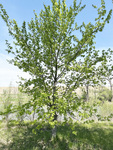
Aceraceae: Acer saccharinum
Files
Family Name
Aceraceae (Sapindaceae)
Common Name
Silver maple, creek maple, water maple
Native American Name
Lakota: tȟahálo
Description
Acer saccharinum is a fast-growing, deciduous tree with a widespread, shallow fibrous root system. Mature trees typically reach 15–30 meters in height, with a broad, rounded to open crown and often multiple trunks. Bark on young stems is smooth and light gray, becoming deeply furrowed and scaly with age. Leaves are opposite, simple, palmately lobed with 5 deeply cut lobes, 10–20 cm long and wide, with coarsely toothed margins. The upper leaf surface is bright green and smooth or slightly rough, while the lower surface is covered with silvery hairs. Petioles are long, 5–15 cm, often reddish. Flowering occurs in early spring (March to April) before leaf emergence. Flowers are found in clusters of 3 to 6, each flower has 4 to 5 small, inconspicuous, and often yellowish-green or reddish sepals and no petals Both male and female flowers have can be on separate trees or on separate branches on the same tree or occasionally within the same flower cluster. Males flowers have 3-7 (12), erect stamens, 5–6 mm long. The females have two bright red, short (barely visible) arching styles. The fruit is a paired samara with wings spreading nearly horizontally, 3–5 cm long, each nutlet 1–1.5 cm wide, maturing from May to June. Silver maple is native to South Dakota and is commonly found along rivers, floodplains, wetlands, and moist woodlands, preferring rich, moist, well-drained soils in full sun to partial shade.
Horticulture Notes
Seed collection: Collect mature samaras in late spring (May–June) when seeds are fully developed and begin to disperse.
Germination: Seeds germinate readily without stratification; sow fresh seeds in spring.
Vegetative propagation: Propagated by softwood cuttings, grafting, or root suckers.
Soils: Prefers moist to wet, fertile, well-drained soils; tolerates occasional flooding.
Light: Thrives in full sun to partial shade.
Water: Prefers consistent moisture; tolerates wet soils better than drought.
Additional Notes
Silver maple is valued horticulturally for its rapid growth and tolerance of wet soils, often used in urban landscaping and riparian restoration. Ecologically, it provides habitat and food for various birds and insects. The wood is soft and used for furniture, pulp, and boxes. The species is susceptible to certain diseases and pests but remains a key native tree in wetland ecosystems.