

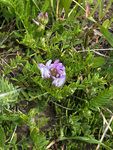
Fabaceae: Astragalus agrestis
Files
Family Name
Fabaceae
Common Name
Field milkvetch
Description
Astragalus agrestis is a perennial, herbaceous plant with a fibrous root system and short, slender rhizomes, forming loose clumps or mats. Mature plants typically reach 15–50 cm in height. Stems are erect to ascending, slender, and sparsely hairy to nearly glabrous. Leaves are alternate, pinnately compound, 5–15 cm long, with 7–15 narrow, linear to lanceolate leaflets, each 1–3 cm long and 2–5 mm wide, with entire margins and acute tips. Leaflet surfaces are green and glabrous or sparsely hairy. Petioles are present, 2–6 cm long. Stipules are present, small, lanceolate, and caducous. Flowering occurs from May to July, with inflorescences forming erect racemes 5–15 cm long, bearing 5–20 pea-like flowers. Flowers are 8–12 mm long, with five free sepals fused at the base, forming a tubular to campanulate (bell-shaped) structure approximately 3–5 mm long. The sepals are lanceolate to ovate, tapering to a pointed tip, and are typically green with fine, soft hairs on the surface, giving a slightly fuzzy texture. There are five petals forming a typical papilionaceous corolla. The banner is 8–12 mm long and about 5–7 mm wide; broadly ovate to broadly elliptic in shape, with a slightly rounded or notched apex, often displaying a pale purple to pinkish hue. The wings are 7–10 mm long and 3–5 mm wide; narrowly oblong to lanceolate, enclosing the keel and slightly shorter than the banner. The keel is 6–9 mm long and 2.5–4 mm wide; narrowly lanceolate and curved, enclosing the reproductive organs. Petal coloration varies from pale purple to pinkish or white. Stamens are ten, nine fused and one free (diadelphous), with yellow anthers. The pistil has a single ovary with a slender style and a capitate stigma. The fruit is a legume pod, 2–4 cm long and about 3–5 mm wide, slender and slightly curved or straight. It is covered with fine, short hairs (pubescent), and typically dehisces (splits open) along both sutures when mature to release seeds. Pods mature from July to August. Field milkvetch is native to South Dakota and occurs in dry to mesic prairies, open woodlands, and rocky slopes, favoring well-drained, sandy or gravelly soils under full sun to partial shade, throughout the state.
Horticulture Notes
Seed collection: Collect mature pods in late summer (July–August) when dry and brown.
Germination: Seeds may require scarification or cold stratification (30–60 days) to break dormancy; sow in fall or in spring after stratification.
Vegetative propagation: Propagated primarily by seed; vegetative methods are rare.
Soils: Prefers well-drained, sandy or gravelly soils; tolerates poor, dry soils.
Light: Requires full sun for optimal growth.
Water: Drought tolerant; prefers dry to moderately moist soils.
Additional Notes
Field milkvetch is valued horticulturally for its attractive pea-like flowers and adaptability to dry, poor soils, making it suitable for prairie restorations and native plant gardens. Ecologically, it contributes to nitrogen fixation, supports pollinators such as bees, and provides forage for wildlife.