

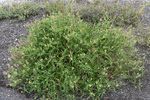
Fabaceae: Astragalus cicer
Files
Family Name
Fabaceae
Common Name
Cicer milkvetch, chickpea milkvetch
Description
Astragalus cicer is a perennial, herbaceous plant with a deep, fibrous root system and rhizomatous growth, forming dense clumps or mats. Mature plants typically reach 50–100 cm in height. Stems are erect, stout, branched, and sparsely hairy to glabrous. Leaves are alternate, pinnately compound, 10–25 cm long, with 15–25 oblong to lanceolate leaflets, each 1.5–3 cm long and 5–10 mm wide, with entire margins and rounded to acute tips. Petioles are 5–15 cm long. Stipules are present, ovate-lanceolate, and caducous. Flowering occurs from June to August, with inflorescences forming dense, erect racemes 10–20 cm long, bearing 20–40 papilionaceous flowers. Flowers are 12–18 mm long, with a calyx forming a tubular to campanulate tube 5–7 mm long, composed of five fused sepals with lanceolate lobes 3–5 mm long, densely covered with fine hairs. The corolla has a prominent banner (standard petal) 12–15 mm long and 8–10 mm wide, broadly ovate with a rounded apex; wings are 10–13 mm long and 4–6 mm wide, narrowly oblong; and the keel is 9–12 mm long and about 3–4 mm wide, narrowly lanceolate and curved, enclosing the reproductive organs. There are ten stamens, diadelphous (nine fused and one free), with yellow anthers. The pistil has a single ovary with a slender style and capitate stigma. The fruit is a legume pod, 6–14 mm long, bladder-like, inflated, and roughly spherical. These are initially green and thinly fleshy, maturing to a stiff, papery, dark brown or black color, and are covered in short, stiff hairs. Each pod typically contains multiple seeds and features a persistent, curved style, dehiscing along two sutures at maturity. Pods mature from August to September. Cicer milkvetch is native to eastern Europe and western Asia, introduced in South Dakota and commonly found in pastures, roadsides, and disturbed sites, thriving in well-drained, fertile soils under full sun.
Additional Notes
Cicer milkvetch is valued horticulturally and agriculturally as a high-quality forage and soil-improving legume with good drought tolerance. Ecologically, it contributes to nitrogen fixation and provides forage for livestock and wildlife. It is widely used in pasture mixes and land reclamation but has escaped and become naturalized.