

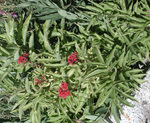
Caprifoliaceae : Sambucus racemosa
Files
Family Name
Caprifoliaceae (Adoxaceae)
Common Name
Red elderberry
Description
Sambucus racemosa is a deciduous, perennial shrub with a fibrous root system and occasionally spreading rhizomes, forming dense thickets. Mature plants typically reach 1–4 meters in height. Stems are erect, stout, and gray brown with smooth bark on young shoots that becomes ridged or furrowed with age. Leaves are opposite, pinnately compound, 15–30 cm long, with 5–9 ovate to lanceolate leaflets, each 5–12 cm long and 2–6 cm wide, serrated margins, and pointed tips. Upper leaf surfaces are medium to dark green and glabrous or sparsely hairy, while lower surfaces are paler with fine hairs along the veins. Petioles are 5–10 cm long. Flowering occurs from May to July, with inflorescences forming dense, erect to spreading panicles 10–20 cm long, bearing numerous small, creamy-white, five-petaled flowers. The calyx has five small, green, ovate sepals, about 1–2 mm long, free and persistent. Petals are five, white, obovate to round, 3–5 mm long, free and spreading. Each flower has five stamens with yellow anthers about 1 mm long. The pistil consists of a single ovary with a slender style and capitate stigma. The fruit is a bright red, spherical drupe, 5–8 mm in diameter, maturing from August to September and persisting into winter. Red elderberry is native to South Dakota and is found the Black Hills in moist woodlands, forest edges, stream banks, and thickets, favoring rich, moist, well-drained soils under partial shade.
Horticulture Notes
Seed collection: Collect ripe berries in late summer to early fall (August–September); seeds are extracted by maceration and washing.
Germination: Seeds require cold, moist stratification (60–90 days) to break dormancy; sow in fall or stratify and sow in spring.
Vegetative propagation: Propagated by softwood cuttings, layering, or root suckers.
Soils: Prefers moist, rich, well-drained soils.
Light: Thrives in partial shade but tolerates full sun in cooler climates.
Water: Prefers consistent moisture; tolerates periodic dryness but not prolonged drought.
Additional Notes
Red elderberry is valued horticulturally for its showy flower clusters and ornamental red berries, often used in native plant gardens and restoration projects. Ecologically, it provides important food for birds and mammals and supports pollinators. The berries have been used traditionally for food and medicine, though they must be cooked to remove toxins.