

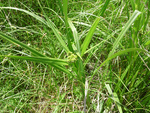
Cyperaceae: Scirpus pallidus
Family Name
Cyperaceae
Common Name
Pale bulrush, pale soft-stem bulrush
Native American Name
Lakota: pȟeží iwíčhakȟoyaka
Description
Scirpus pallidus is a perennial, herbaceous sedge that typically forms dense clumps or loose colonies. It grows from a robust, fibrous root system with well-developed, creeping rhizomes. Plants usually range from 50 to 120 cm tall. The stems (culms) are erect, slender, trigonous in cross-section, smooth, and soft, often pale green to green in color. Leaves are mostly basal and reduced, with long, sheathing leaf bases and narrow, grass-like blades; leaf blades can be up to 30 cm long up to 18 mm wide, typically flat or slightly channeled, smooth with a lighter green below and darker above. The sheath at the base is closed, smooth, and often tinged brown or reddish; the collar is indistinct, and the ligule is absent or represented by a short membrane. Flowering occurs from June to August. The inflorescence is a terminal, open to compact panicle (or sometimes head-like cluster), subtended by several leaf-like bracts, with many small spikelets, 2–7 cm across, with each spikelet 5–10 mm long and 2–3 mm wide. Each spikelet is subtended by a scale. The perianth consists of six reduced, bristle-like structures which may aid in seed dispersal. Stamens number three, with slender, pale filaments and small, light brown anthers. The pistil is single, with a short style and a three-branched stigma. Fruit is a small, lenticular achene, 1 mm long, brown at maturity, and matures from late July through September. Pale bulrush is native to South Dakota, found primarily in the eastern and central parts of the state in wet prairies, marshes, streambanks, and along the margins of shallow lakes and ponds.
Horticulture Notes
Seed collection: Collect mature achenes from late summer to early fall; allow to dry before storage.
Seed germination: Seeds benefit from cold-moist stratification (30–90 days); best sown in moist conditions.
Vegetative propagation: Rhizome division in early spring or fall is effective.
Soils: Prefers saturated, mucky, or silty soils; tolerates some standing water.
Light: Full sun to partial shade.
Water: Requires consistently moist to wet sites; tolerates shallow flooding.
Additional Notes
Pale bulrush is valued for its role in wetland restoration, erosion control, and as a habitat plant for waterfowl and other wildlife. It stabilizes soil in wet environments and contributes to water filtration.