

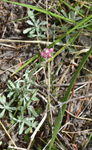
Asteraceae: Antennaria rosea
Files
Family Name
Asteraceae
Common Name
Rosy Pussytoes, Rosy Everlasting, Alpine Pussytoes
Description
Antennaria rosea is a low-growing perennial, herbaceous forb that forms dense, expansive mats via a shallow, fibrous root system seamlessly interconnected by a network of short, creeping stolons and shallow rhizomes. During its early vegetative phase, the foliage is prostrate, but later erect, simple, unbranched flowering stems reach a plant height of 10 to 40 cm tall. The stem is slender, erect, and cloaked in a dense coat of downy, white-woolly hairs. There is a basal rosette of numerous leaves alongside fewer, smaller, alternate cauline leaves distributed sparsely upward along the stem. The leaves are simple with an entire margin; basal blades are spatulate, oblanceolate, or obovate, measuring 1 to 4 cm long and 2 to 7 mm wide, while the upper cauline leaves are reduced, linear, and tipped with a small, sharp point. The leaf color is grayish green to silvery-white; the upper surfaces are thinly hairy to smooth with age, the lower surfaces remain densely, persistently woolly-white. The leaf bases narrow gradually into a sessile attachment. Flowering occurs in early to mid-summer, primarily from June to August. The inflorescence type is a compact, crowded terminal cluster (cyme) composed of 3 to 20 individual flower heads surrounded by a distinct involucre measuring 4 to 7 mm tall. The involucre is lined with multi-series, wide, pointed bracts that are conspicuously colored in shades of rose-pink, bright red, or occasionally cream-white, featuring a dry, papery, everlasting texture. The pappus consists of a single series of numerous, capillary, hair-like bristles measuring 5 to 7 mm long. The heads contain narrow, tubular disk florets that are cream or pale yellow. This species is functionally dioecious, but populations are almost exclusively comprised of asexually reproducing (apomictic) female clones. Consequently, stamens are typically absent or vestigial in these female populations; when rare male flowers occur, they possess 5 small stamens with yellow, fused anthers. The pistil structure features a single inferior ovary topped by an elongated, slender style that bifurcates into two distinct, receptive stigma branches. The fruit is a small, dry, single-seeded achene (cypsela) less than 2 mm long, which transitions from green to a dark tan or grey-brown color at maturity from July to August. Each achene remains attached to the persistent, feathery pappus, enabling broad wind dispersal across open country. Rosy pussytoes is native to South Dakota, where they are primarily concentrated in the western portion of the state, particularly across the rugged limestone ridges, granite outcrops, and open ponderosa pine forests of the Black Hills, as well as the dry, open shortgrass plains and hillsides of the surrounding prairies.
Horticulture Notes
Seed Collection: Gather the fuzzy seed heads in mid to late summer (July to August) once the achenes turn dark greyish-brown and easily separate from the dry receptacle when gently rubbed. Store the thoroughly dried seeds in paper bags or sealed containers in a cool, dark environment (3°C to 5°C) to maintain good viability.
Seed Germination: Seeds are not dormant. Surface-sow the seeds onto a moist medium without covering them, as light is required for germination.
Vegetative Propagation: Plants are easily multiplied by stoloniferous divisions or by separating individual rooted rosettes from the edges of the mat during early spring or early autumn dormancy.
Soils: Adapted to poor, lean, coarse-textured, well drained soils including sandy, gravelly, or rocky loams. Wide tolerance for soil pH (acidic, neutral, to mildly alkaline) but intolerant of heavy, waterlogged clay or over-fertilized soils
Light: Full sun conditions (6 to 8+ hours of direct daily sunlight) to maintain its dense, compact mat form and vibrant silver foliage.
Water: Exceptional drought tolerance once established, preferring dry to average moisture conditions. No tolerance for wet winters or standing water.
Additional Notes
Rosy pussytoes provides exceptional horticultural value as a durable, evergreen, mat-forming groundcover ideal for native rock gardens, alpine troughs, and xeriscape borders where it effortlessly suppresses weeds. Ecologically, it is highly valued as a tough conservation plant for erosion control on exposed slopes and serves as a specialized host plant for American Painted Lady butterfly caterpillars. Humans occasionally harvest the attractive, papery pink flower clusters for use as long-lasting elements in dried floral arrangements and crafts.