

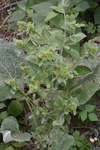
Asteraceae: Arctium minus
Files
Family Name
Asteraceae
Common Name
Lesser Burdock, Common Burdock, Wild Burdock
Native American Name
Lakota: waȟpé tȟáŋka
Description
Arctium minus is a biennial, taprooted, herbaceous plant. In its second year of growth, it reaches a typical height of 0.5 to 1.5 m (occasionally up to 2.0 m) supported by an erect, stout, grooved, and highly branched stem that is rough hairy to slightly woolly. The leaves are simple and alternate; they feature a dull green upper surface that is glabrous to sparsely hairy, and a light green, densely woolly lower surface. Lower basal leaves are broadly ovate, cordate at the base, up to 50 cm long and 40 cm wide, with hollow petioles measuring 10 cm to 30 cm in length, while upper stem leaves are significantly smaller and short-petioled. Flowering occurs from July to October, displaying a panicle-like inflorescence of numerous, discoid flower heads. Each head measures 1.5 - 2.5 cm in diameter and is surrounded by a subglobose involucre composed of multi-seriate, rigid bracts that taper into sharp, inwardly hooked spines. The pappus consists of numerous short, rigid, yellowish-brown, bristly scales, 1 to 3 mm long. The disc flowers have pink to purple, fused tubular petals that form 5-lobed florets about 9 to13 mm long. There are 5 stamens featuring purple, fused anthers that form a cylinder around the style. The single pistil consists of an inferior ovary, a slender white style, and a deeply cleft, purplish stigma that emerges above the anther tube. The fruit is an oblong, slightly compressed, 3- to 5-angled achene (cypsela), measuring 5 to 7 mm long, colored gray brown with dark mottling, reaching maturity from August to November. Lesser Burdock is an introduced species in South Dakota, native to Europe, Asia, and North Africa; it is widely naturalized across the entire state in disturbed areas, roadsides, pastures, forest edges, and waste grounds.
Additional Notes
Lesser burdock has minimal ornamental value in horticulture and is widely categorized as a noxious or invasive weed due to its aggressive spread and competitive growth. Ecologically, its abundant nectar and pollen provide a valuable food source for honeybees, bumblebees, and butterflies during the late summer months. Humans historically and culturally utilize the plant, particularly in traditional medicine where the taproot is used as a diuretic and blood purifier, and the young, peeled stalks and first-year roots are consumed as a cooked vegetable.