

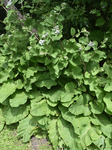
Asteraceae: Arctium tomentosum
Files
Family Name
Asteraceae
Common Name
Woolly Burdock, Downy Burdock
Description
Arctium tomentosum is a biennial, taprooted, herbaceous plant. In its second year of growth, it reaches a height of 1.0 to 2.5 m, featuring an erect, stout stem that produces ascending branches minutely covered in glandular and distally wooly hairs. The simple, alternate leaves are green and glabrous to sparsely hairy on the upper surface and display a densely felted, grayish-white, tomentose layer on the lower surface. Basal leaves are strongly heart-shaped (cordate) with toothed margins, measuring 20 to 50 cm long and 10 to 30 cm wide, supported by solid or hollow petioles up to 30 cm long. The upper cauline leaves are drastically reduced and short-petioled. Flowering occurs from July to October, producing a distinct corymbiform array of flower heads. Each individual head measures 1.5 to (2.5 cm in diameter, with a globose involucre heavily charactered by a dense, webby, cobweb-like mass of white hairs. This involucre is composed of multi-seriate, rigid phyllaries where the inner bracts are widened, purple-tipped, and straight, while the outer and mid-bracts taper into sharp, inwardly hooked spines. The pappus consists of a crown of short, rigid, bristles measuring 1 to 3 mm in length. The diac flowers have purplish red, fused tubular petals that form 5-lobed florets about 9 to 12 mm long, with distinctly glandular-pubescent corolla limbs. There are 5 stamens featuring purple, fused anthers that encircle the central reproductive column. The single pistil consists of an inferior ovary, a long white style, and a deeply bifid, purplish stigma extending above the staminal cylinder. The fruit is a slightly compressed, oblong, 3- to 5-angled achene (cypsela), measuring 5 to 8 mm long, light brown to gray-brown with subtle dark mottling, which reaches full maturity from late August to November. Woolly Burdock is an introduced species in South Dakota, native to temperate Eurasia; it occurs sporadically across eastern and western counties of the state, thriving primarily in anthropogenic spaces, meadows, fields, roadsides, and disturbed waste areas.
Additional Notes
Woolly Burdock possesses no structural or aesthetic value for intentional horticultural use and is widely categorized as an invasive or noxious weed due to its aggressive seed production. Ecologically, the late-summer flowers produce copious quantities of nectar and pollen that sustain diverse populations of honeybees, bumblebees, and native pollinators when other floral resources diminish. Humans harvest and process the plant for ethnobotanical uses; the long taproots are utilized in traditional European folk medicine as a blood-purifying diuretic, and the tender, young petioles and first-year roots can be peeled and boiled as an edible wild vegetable.