

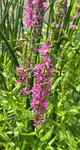
Lythraceae: Lythrum salicaria
Files
Family Name
Lythraceae
Common Name
Purple loosestrife, spiked loosestrife
Description
Lythrum salicaria is a hardy perennial herbaceous forb that develops a dense, woody taproot system anchored alongside a thick, creeping rhizome network capable of forming massive clonal colonies. The plant typically reaches heights of 1 to 2.5 m and bears stiff, erect, distinctly 4-to-6-angled square stems that display ascending branches and become subwoody and sparsely to densely pubescent with age. Leaf insertion is primarily opposite or arranged in whorls of 3, transitioning to alternate near the stem apex. The simple, lanceolate to ovate-lanceolate leaves are medium-green, 3 to 10 cm long, 1 to 2.5 cm wide, feature smooth entire margins, have rounded to heart-shaped subclasping bases, and lack petioles. The leaf blades are downy pubescent to weakly tomentose on both upper and lower surfaces. Flowering occurs from June through September. The showy terminal inflorescence spike that spans 10 to 40 cm in length. The persistent sepals are fused into a tubular, heavily veined 5-to-7-toothed calyx tube (hypanthium) measuring 4 to 6 mm long, shaded green to dull purple, and with narrow appendages between sepals that are 2.5 to 3 mm long and extend past the sepals. The 5 to 7 petals are free, obovate, wrinkled, magenta-pink to deep purple, and measure 7 to 12 mm long and 2 to 4 mm wide. Flowers contain 12 stamens arranged in two distinct whorls of alternating lengths (short, medium, or long) featuring yellow to greenish-purple filaments and dark anthers. The single compound pistil contains an ovary with a long, medium, or short style topped by a green, capitate stigma. The fruit is an oblong, 2-valved capsule measuring 3 to 5 mm long, which transitions from green to a dry, papery brown at maturity. Fruit capsules ripen progressively from late July through October, splitting open to release hundreds of microscopic, brown, hairless seeds. Purple loosestrife is not native to South Dakota. It is an aggressive, introduced weed native to temperate Eurasia and northern Africa that has naturalized along the Missouri River, urban drainage basins, and lake shores across southeastern and western South Dakota. It thrives in wet, sunlit habitats including marshes, wet meadows, prairie potholes, riverbanks, and roadside ditches.
Additional Notes
Purple loosestrife was introduced to North America as a highly valued garden ornamental due to its exceptionally long blooming window, hardy nature, and vibrant magenta flower spikes. Ecologically, however, it is a highly destructive invasive species across North American wetlands. It degrades native ecosystems by outcompeting critical native plants like cattails, reducing biodiversity, and diminishing the quality of forage and nesting sites for native waterfowl and wildlife.