

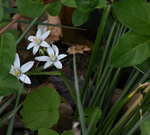
Liliaceae: Ornithogalum umbellatum
Files
Family Name
Liliaceae
Common Name
Garden Star-of-Bethlehem, Common Star-of-Bethlehem
Description
Ornithogalum umbellatum is a perennial, scapose herbaceous forb that arises from a subterranean bulbous root system; the main globose bulb is typically surrounded by numerous small, clustered ovoid offsetting bulbils. The plant reaches a height of 15 to 30 cm. It features an erect, glabrous, unbranched, leafless stem (scape) that emerges directly from the basal tufted rosulate leaf clusters. The leaves are simple, linear, elongate, succulent, and glabrous. They exhibit a deep green color, accented by a prominent, light green to white central midvein running along the upper surface. Each leaf blade measures 20 to 60 cm in length and 2 to 8 mm in width, tapering to a point, and lacking a distinct petiole. Flowering occurs from April to June, with individual flowers opening in the late morning or afternoon. The inflorescence is a terminal, flat-topped corymbose raceme spanning 5 to 10 cm across, supporting 3 to 20 flowers on ascending pedicels. The perianth consists of 6 free, distinct, petaloid tepals arranged in two whorls of 3. The outer 3 tepals are lanceolate-oblong, 15 to 30 mm long and 3 to 5 mm wide, featuring a bright white upper surface and a broad, distinguishing longitudinal green stripe on the lower surface. The inner 3 tepals share an identical size, shape, and color scheme. The androecium consists of 6 distinct stamens; the filaments are white, flattened, and petaloid, measuring about 5 to 8 mm long, capped by small, pale yellow anthers. The gynoecium features a single pistil with a superior, deeply 6-ribbed, 3-locular ovoid ovary, a short, stout style, and a capitate, 3-lobed stigma. The fruit is an erect, 3-valved, obovate to oblong capsule measuring 8 to 18 mm in length, remaining green until it dries to a yellowish-brown color upon reaching maturity in mid-to-late summer (June to July). The garden star-of-Bethlehem is not native to South Dakota; it is an introduced species native to Europe, North Africa, and the Middle East. It has naturalized locally in southeastern and central South Dakota, primarily invading disturbed areas, lawns, gardens, old homesites, pastures, open woodlands, and semi-shaded stream banks.
Additional Notes
The garden star-of-Bethlehem is valued in horticulture for its resilient nature and its striking, starry white spring blooms. However, it is highly opportunistic and frequently regarded as a aggressive weed or invasive pest because its rapidly multiplying bulbils displace native spring flora. Ecologically, the flowers provide early-season nectar and pollen to native bees, but all parts of the plant contain toxic cardenolides (cardiac glycosides) that are dangerous and potentially lethal to cattle, horses, and humans if ingested.