

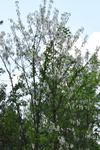
Fabaceae: Robinia pseudoacacia
Files
Family Name
Fabaceae
Common Name
Black locust, false acacia
Description
Robinia pseudoacacia is a perennial, deciduous hardwood tree featuring a wide-spreading fibrous root system characterized by a shallow taproot and extensive lateral roots that aggressively produce root suckers. It reaches a mature plant height of 9 to 21 m. The stem is a relatively straight trunk with an open, irregular crown of crooked, brittle branches; the twigs are zigzag, angular, and red brown with prominent lenticels. The bark on older wood is thick, dark reddish-brown to blackish-gray, and deeply furrowed into heavily ridged rope-like patterns. Leaf insertion is alternate along the twigs. The leaves are odd-pinnately compound and 15 to 36 cm long, composed of 7 to 29 leaflets. Each leaflet is dark blue green on the upper surface and lighter green below; they are oval to ovate oblong in shape, 2.5 to 5 cm long, and 1.3 to 2 cm wide with entire margins and rounded, obtuse apices. A distinct petiole is present, measuring 2.5 to 5 cm long. Paired, heavily lignified stipules modify into sharp, stout spines measuring 0.6 to 1.3 cm long at each leaf scar on young shoots and juvenile wood, though they are frequently absent on older, slower-growing branches. Flowering occurs from April to June for a brief duration of approximately 10 days. The inflorescence is a dense, pendulous, unbranched raceme measuring 10 to 20 cm in length. The sepals form a campanulate, 5-lobed calyx tube that is fused, short about 5 to 7 mm long and wide, dark reddish green to purple, and covered in fine hairs. The petals comprise a showy papilionaceous corolla that is creamy white with a distinct yellow spot on the standard petal; the individual petals are free (except for the partially fused keel petals), intensely fragrant, and measure 15 to 20 mm long. There are 10 stamens total, arranged in a diadelphous configuration where 9 filaments are fused into a tube and 1 remains free; they are about 15 mm long with white filaments and small yellow anther heads. The single superior pistil is about 15 to 18 mm long with a linear, green ovary, a curved, slender style, and a small, terminal, capitate stigma. The fruit is a flat, linear-oblong, dehiscent leguminous pod measuring 5 to 10 cm long and 1.3 mm wide. It turns from green to a smooth, dark reddish-brown color upon reaching maturity between September and October, frequently persisting on the naked branches through the winter months. The black locust is not native to South Dakota; it is native to the southeastern United States, primarily the southern and central Appalachian Mountains and the Interior Highlands. It has been widely introduced and naturalized across eastern and central South Dakota, where it is commonly found in disturbed woodlands, degraded forest edges, old fields, fence rows, and along sunny roadcuts.
Additional Notes
Black locust is highly valued in horticulture as a fast-growing shade tree that adapts effortlessly to highly compacted urban areas, dry soils, and reclamation sites. Ecologically, it acts as a pioneer plant capable of fixing atmospheric nitrogen through symbiotic root bacteria, which enriches poor or degraded soils but can also facilitate the spread of non-native weeds in fragile ecosystems. The highly fragrant blossoms serve as a premier nectar source for honeybees, producing a light, premium grade honey. Beyond landscaping, humans utilize its dense, rot-resistant wood for exceptionally durable fence posts, tool handles, and firewood.