

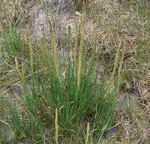
Juncaginaceae: Triglochin maritima L.
Family Name
Juncaginaceae
Common Name
)Seaside arrowgrass, northern arrowgrass
Description
Triglochin maritima is a long-lived perennial, densely tufted, grass-like herbaceous monocot arising from a thick, stout, woody rhizome. The plant reaches a height of 30 to 100 cm at full maturity. Its flowering stems (scapes) are erect, unbranched, leafless, smooth, and stout. The leaves are entirely basal, simple, linear, alternate, and visually resemble thick blades of grass. They are bright green to deep green, measuring 8 to 30 cm long and about 2 to 5 mm wide. The leaf surfaces are fleshy, smooth, and glabrous; they feature a rounded or crescent-shaped cross-section that is flat or slightly channeled on the upper surface and rounded on the lower surface. The leaves transition directly into a wide, open, membranous sheathing base that clasps the stem. At the junction of the leaf sheath and blade, there is a prominent membranous ligule that measures 1.5 to 5 mm long with an entire or slightly notched/bilobed tip. Flowering occurs from May through August. The inflorescence is a dense, spikelike, terminal raceme measuring 10 to 40 cm in length, borne well above the foliage. The tiny, wind-pollinated flowers lack true distinct sepals and petals, featuring instead a perianth composed of 6 scale-like, yellowish green to purple-tinged segments arranged in two whorls of three. The outer three segments and the inner three segments are all free, concave, and roughly 2 mm long. The flower contains 6 stamens with short, nearly sessile filaments that are weakly fused to the base of the perianth segments; they carry small, greenish-yellow anthers. The compound pistil consists of 6 fully fertile, fused carpels with 6 sessile, feathery, papillate stigmas. The fruit is an oblong to almost cylindrical schizocarp, 3 to 8 mm long, which splits completely at maturity into 6 distinct, single-seeded mericarps. These fruits ripen from green to a dark brown color between July and October. Seaside arrowgrass is native to South Dakota, where it can be found locally within glaciated wetland regions, particularly in fens, wet alkaline lowlands, and brackish or saline marshes.
Horticulture Notes
Seed Collection: Collect the dark brown, dry schizocarps by hand-stripping them from the tall flowering scapes from August through October before they drop naturally.
Seed Germination: Seeds require 60 to 90 days of cold, moist stratification at 1–4°C to break dormancy, followed by exposure to light and warm temperatures for optimal spring germination. Surface sowing in the fall is recommended.
Vegetative Propagation: Propagate by digging up and dividing established tufts or rhizome clumps during the early spring dormancy period or in late autumn.
Soils: Prefers fine to medium-textured loams, silts, or clays with neutral to highly alkaline pH levels; it exhibits a remarkably high tolerance for brackish, saline, or calcareous substrates.
Light: Full sun, it is completely intolerant of shade.
Water: Requires constantly wet, saturated, or poorly drained soils, and readily tolerates seasonal water inundation, shallow standing water, and heavy winds.
Additional Notes
Seaside arrowgrass functions as a valuable ecosystem engineer in coastal and inland wetlands by trapping sediment and altering microhabitats to enhance overall plant diversity. It provides specialized cover and foraging grounds for various wetland insects, waterfowl, and shorebirds. While ecologically beneficial, all parts of the fresh plant generate toxic cyanogenic glycosides that can release lethal amounts of hydrogen cyanide when bruised or eaten, making it dangerously poisonous to cattle, sheep, and other ruminant livestock during spring grazing. Horticulturally, it is rarely used in standard residential landscaping but serves as a vital component in wetland mitigation, shoreline restoration, and rain garden installations designed for saline or brackish water purification.